
Late August to early April
Visit Tromsø says the northern lights may be visible from late August to early April whenever the sky is dark and clear enough, often most active around 20:00–02:00 — never guaranteed.
Source: Visit TromsøBeneath the auroral oval — with polar night in winter and no darkness at all in summer.
Calculated for Telegrafbukta beach (69.634, 18.911)Local time GMT+1 (UTC+1)
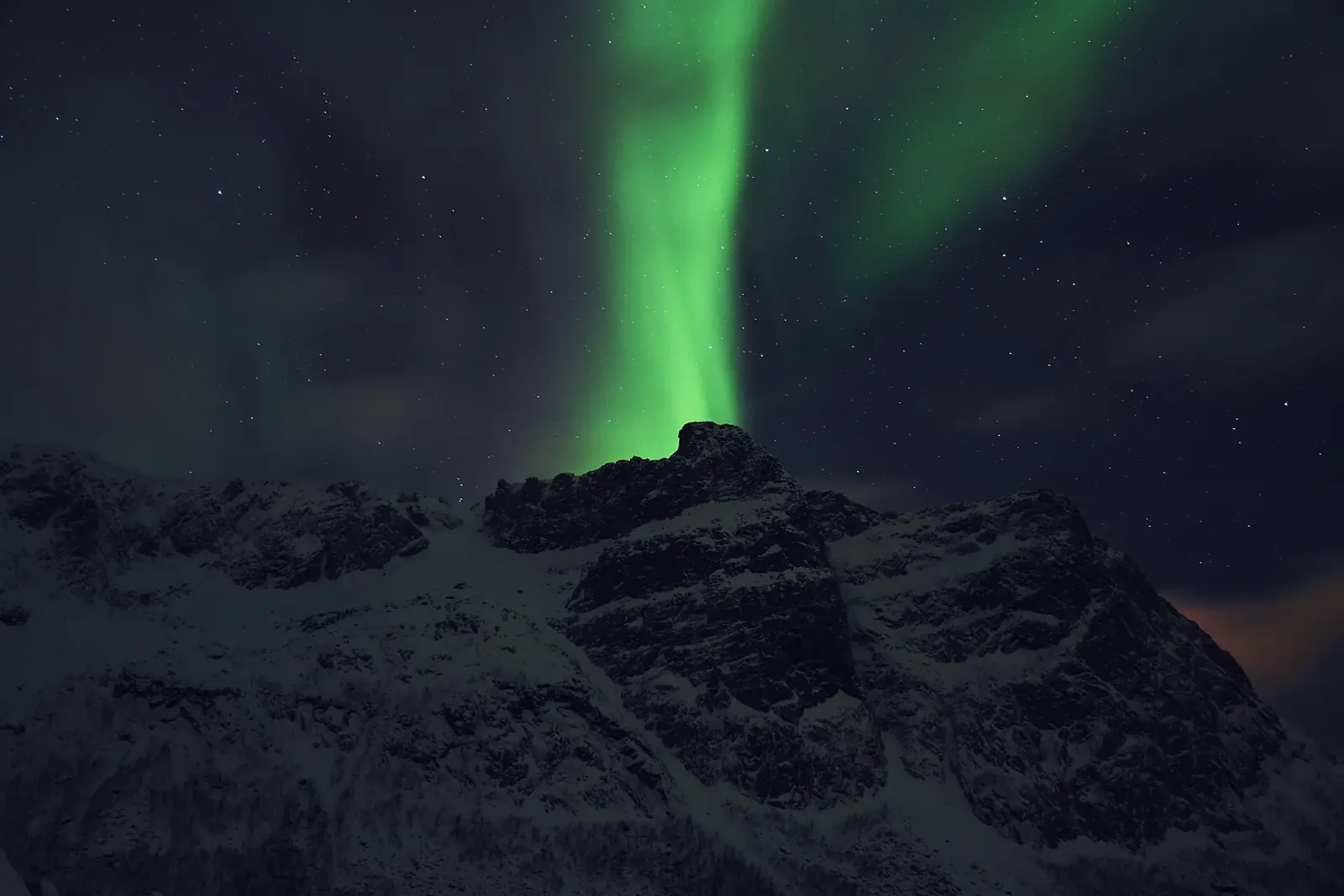
Aurora at Telegrafbukta beach
Wait for a real gap in the clouds.
Cloud or rain at the NOAA forecast time blocks a useful local check, even if activity is modeled above it.
Astronomical darkness is this planner’s conservative recommendation threshold, not a physical aurora visibility cutoff. Aurora can sometimes be visible in twilight.
Stargazing at Telegrafbukta beachForecast
Skip tonight. Monday will be much better.
Don't bother tonight — plan for Monday instead.
Rain is forecast elsewhere in the night · Heavy cloud, 100% night average · Moon is nearly dark (5%) · 10.9 h of full darkness · Nothing on tonight's list rates well
Go means conditions are usable; Wait is shown only when remaining earlier scored hours support a timing improvement; Later window means there is no demonstrated reason to delay. Neither label ranks places. The window is selected by hourly cloud, darkness, Moon altitude and rain, with whole-night context in the verdict. It is not a guarantee or proof that earlier hours are unusable. Artificial light, terrain, access and personal safety are not scored. The former confidence percentage was an uncalibrated internal heuristic using forecast coverage, cloud variation, rain and score margin — not the probability of clear weather or a successful outing. It is no longer shown here.
Sunset
14:19
Cloud at sunset: no forecast
Full darkness
18:01
Sun 18° below horizon
Best stargazing window
No usable window
Inside astronomical darkness · Tonight engine
Night cloud
100%
Live forecast in use
Moon
5% lit
Waning Crescent · up ≈0% of dark hours
Aurora
Wait for a real gap in the clouds.
NOAA OVATION assessment
Evening of Fri 6 NovAstronomy
14:19
Sunset
15:37
Civil twilight ends
16:52
Nautical twilight ends
18:01
Astronomical darkness
Astronomical darkness begins at 18:01. Faint-star and Milky Way visibility also depends on cloud, Moon, artificial light and the local horizon. Morning: darkness ends 04:56, sunrise 08:41.
Times in Europe/Oslo (GMT+1, UTC+1). This zone observes daylight saving time; no change in the next eight days.
Fri 6 NovAstronomy
The Moon is below the horizon in the sampled dark hours; cloud and local lighting still affect the sky.
Galactic centre in SagittariusAstronomy
The Galactic Centre never rises above the horizon at Telegrafbukta beach. Other parts of the Milky Way may still be visible on dark, clear nights away from lights.
The window needs astronomical darkness and the core at least 2° up. Core positions include refraction and are sampled each minute; these are timing estimates, not guaranteed visibility. Hills, trees and town glow near the horizon can still hide it.
Above the horizon vs. easy to seeAstronomy
"Favourable geometry" means at least 10° up while the Sun is 12° or more below the horizon. Cloud, Moon and local obstructions are not included; positions are sampled every 15 minutes.
Tonight · OrionidsForecast
Skip tonight — cloud
Rates are approximate modelled estimates, not measured or guaranteed counts. Observing windows use 30-minute samples: any start or end is approximate and may differ by almost 30 minutes from a continuous crossing. Radiants use fixed peak positions; daily radiant drift is not modelled. The model assumes a fixed, moderately dark sky; town light can cut what you see well below these figures.
Coming upAstronomy
Year-specific IMO predictions, not guaranteed or observed peaks. Date-only maxima are not assigned an invented local hour. The rate model above still uses typical annual peak dates and fixed radiant positions; it does not model the published peak ranges or daily radiant drift.
Lowest-cloud evening (weather only): Sat 7 Nov (lowest mean night cloud). The overall recommendation at the top also weighs moonlight and darkness, so it can name a different night. Cloud is shown only where the forecast covers the night. Values come from an eight-day forecast — the later evenings are less certain than the first, so check again close to the date.
| Evening | Sunset | Full dark | Moon | Night cloudForecast |
|---|---|---|---|---|
| Sat 7 NovLowest cloud | 14:14 | 17:58 | 2% · down | 100% |
| Sun 8 Nov | 14:09 | 17:55 | 0% · down | 100% |
| Mon 9 Nov | 14:04 | 17:52 | 1% · down | Beyond forecast |
| Tue 10 Nov | 13:59 | 17:49 | 3% · down | Beyond forecast |
| Wed 11 Nov | 13:54 | 17:47 | 7% · down | Beyond forecast |
| Thu 12 Nov | 13:48 | 17:44 | 12% · down | Beyond forecast |
| Fri 13 Nov | 13:43 | 17:41 | 19% · down | Beyond forecast |
| Sat 14 Nov | 13:37 | 17:38 | 27% · down | Beyond forecast |
Astronomy only. No weather is given for this selected date. Moon-up percentages are approximate 15-minute samples across astronomical darkness; Milky Way positions include refraction and one-minute sampling, not visibility guarantees.
Astronomy on the 15th of each month — not a weather or climate forecast. Each core window uses astronomical darkness and its stated altitude threshold (10°, or a lower 5°/2° threshold when the core stays low). Low-altitude windows are marginal geometry, not equivalent to a 10° window or a visibility recommendation.Astronomy
| Month | Full darkness | Milky Way core in darkness |
|---|---|---|
| Jan | 12.6 h | — |
| Feb | 9.5 h | — |
| Mar | 4.9 h | — |
| Apr | None — twilight all night | — |
| May | None — twilight all night | — |
| Jun | Midnight sun | — |
| Jul | Midnight sun | — |
| Aug | None — twilight all night | — |
| Sept | None — twilight all night | — |
| Oct | 8.2 h | — |
| Nov | 11.8 h | — |
| Dec | Polar night · 13.5 h astronomical dark | — |
Sources are linked below. Tourism descriptions do not confirm current access, closures or safety. Sky calculations use an ideal horizon, not local mountain or building profiles.
Visit Tromsø says the northern lights may be visible from late August to early April whenever the sky is dark and clear enough, often most active around 20:00–02:00 — never guaranteed.
Source: Visit TromsøTromsø lies directly below the northern lights oval, which is why modest activity can already reach the sky overhead.
Source: Visit TromsøPolar night lasts roughly from 27 November to 15 January. The Sun stays below the horizon, but there are still a few hours of twilight each day.
Source: Visit TromsøAurora activity continues in summer, but the midnight sun makes the sky too bright to see it.
Source: Visit TromsøHead to places outside the city centre with little or no artificial light. Check cloud as well as aurora activity.
Source: Visit TromsøTelegrafbukta on the south of Tromsøya is a walking and ski area where, on a clear evening, you may see the northern lights. Check current routes and timetables with Svipper.
Source: Visit TromsøWhy this calculation point: A documented aurora spot on Tromsøya, reachable by local bus.
Forecast fetched Sat 7 Nov, 04:06 local time · weather: Live forecast in use. Astronomy: astronomy-engine, twilight on the geometric Sun (USNO convention), times rounded to the nearest minute.