The galactic core, explained
Whether the core clears your horizon at all depends on latitude and season — the galactic geometry below is the same for everyone.
Can you see the Milky Way tonight?
This page is a Milky Way timing tool. Set a location and it calculates, for tonight and your coordinates, what time the galactic core rises, when it reaches its highest point and how high that is, which of those hours fall inside real astronomical darkness, how much the Moon interferes, and what the cloud forecast does to the window. Rise time depends entirely on your date and latitude, so no single clock time can be given before that.
Galactic core tonight · Monday 19 October
The core crosses the meridian near 16:12 local solar time
Sagittarius A* sits at declination -28.9°, so the bright core never rises for anyone north of about 61° N and never sets south of about 61° S. Tonight it is 62° from the Sun, and the Moon is 53% lit.
- Core position
- RA 17.8h, Dec -28.9°
- Meridian crossing
- 16:12 local solar
- Angle from the Sun
- 62°
- Moon interference
- 53% lit
- Northern limit
- 61° N
- Southern advantage
- 61° S
Sagittarius A*, J2000
Same solar-clock reading at every longitude
Far enough from the Sun to clear twilight somewhere on Earth
Bright enough to wash out the fainter structure
North of this the core stays below the horizon all year
South of this the core never sets
Declination, meridian-crossing solar time, angle from the Sun and the Moon's phase are the same for everyone tonight. How high the core actually climbs from your horizon, whether that happens while your sky is astronomically dark, and whether cloud will cover it are local — SnapCosmos answers those, with a verdict and a confidence, once it knows where you are.
What this page calculates
What time does the Milky Way core rise tonight?
There is no single answer for everyone: the hour depends on your date and your latitude. Set a location and this page computes it from the galactic core's own position.
The Milky Way is a band that circles the whole sky, so it never "rises" at one moment. What has a rise time is the galactic core — the bright bulge toward Sagittarius, at declination −29°. That is the object this page times.
Once a location is set, the page calculates for tonight:
- Core rise — when the galactic core crosses your horizon.
- Highest point — its culmination, and the highest altitude it actually reaches while the sky is dark.
- Maximum altitude — in degrees, because a core at 5° is nothing like a core at 60°.
- Darkness overlap — which of those hours fall inside real astronomical darkness rather than lingering twilight.
- Moon interference — illumination and whether the Moon is above your horizon during that window.
- Cloud — tonight's forecast folded into the verdict.
- Best viewing window — the stretch where dark hours and a usefully high core overlap.
Season and latitude set the outer limits. From mid-northern latitudes the core is a late-spring to early-autumn object that never climbs far above the southern horizon; from southern latitudes it passes close to overhead for much of the year. In deep northern winter it is below the horizon during the dark hours entirely, and only the fainter winter Milky Way through Cygnus and Cassiopeia remains.
Location not set
Set a location for tonight's core rise time and verdict
The core of the galaxy is only above the horizon for part of the year, and only for part of the night — and both the hour it rises and the hour it peaks depend entirely on where you are.
- What time the galactic core rises tonight
- When it reaches its highest point, and how high
- Which of those hours are in real astronomical darkness
- Moon interference and tonight's cloud cover
Your choice stays in this browser. Nothing is sent to a SnapCosmos server.
Practical
How to actually see it
The Milky Way is not a difficult object. It's a hidden one — hidden by the sky glow of nearly every populated place on Earth.
Get to a dark site. Aim for Bortle 4 or darker. In practice that's typically 40–100 km beyond a major city and often much less from a small town. A single well-chosen drive can be the difference between "I think I see something" and a jaw-drop.
Time it around the Moon. Any Moon above the horizon brighter than about 30% will drown the fainter regions. Use our Moon page to find the New Moon window in the next month, or the short interval after Moonset tonight.
Face south (Northern Hemisphere). The core rises in the southeast and sets in the southwest. In the Southern Hemisphere it can pass nearly overhead — the best Milky Way views on Earth.
Bring binoculars, not a telescope. The Milky Way is a huge, low-contrast object. A wide field turns star clouds and dark lanes into a three-dimensional landscape; a narrow-field telescope reduces it to a bright starfield. Save the telescope for the planets.
Astrophotography
Exposure table — pin-sharp stars
The old '500 rule' (500 ÷ focal length) is generous on modern high-resolution sensors and lets stars trail. The NPF rule accounts for aperture and pixel pitch and typically gives about 60% of the 500 rule for a full-frame sensor at f/2.8. Use these as starting points.
| Focal length | Aperture | ISO | Shutter (full-frame) |
|---|---|---|---|
| 14 mm | f/2.8 | 3200 | 25 s |
| 20 mm | f/2.8 | 3200 | 17.5 s |
| 24 mm | f/2.8 | 6400 | 14.6 s |
| 35 mm | f/2.8 | 6400 | 10 s |
| 50 mm | f/2.8 | 6400 | 7 s |
- • Crop-sensor cameras: multiply focal length by 1.5× (APS-C) or 2× (m4/3) before reading the table.
- • Shoot in RAW. Underexpose by half a stop rather than blow the core highlights.
- • Focus manually on a bright star using live-view at 10×. Autofocus fails on the night sky.
- • Turn off in-body stabilization on a tripod — it can introduce drift.
Year-round
When the core is visible from your latitude
The galactic core sits at declination −29°. Where you are on Earth decides how many months of the year it climbs above your horizon at night.
At 59.9° latitude, the galactic core is best visible: Late April → early September (low above southern horizon). Outside this window it sits below the horizon during the dark hours, and only the fainter winter Milky Way — passing through Cygnus, Cassiopeia and Auriga — remains available overhead.
The northern hemisphere gets the core low and short; the southern hemisphere gets it high and long. Nowhere in the world matches southern Chile, New Zealand or the outback for sheer Milky Way overhead time.
| Latitude band | Best months | Peak altitude | Typical hour |
|---|---|---|---|
| 60°N (Oslo, Stockholm, Anchorage) | Late May – early August | ~ 5° | Around local midnight |
| 50°N (London, Berlin, Vancouver) | May – September | ~ 12° | 01:00–02:00 local |
| 40°N (Madrid, New York, Beijing) | April – October | ~ 22° | Midnight ± 2 h |
| 30°N (Cairo, Houston, Delhi) | March – November | ~ 32° | Late evening |
| 0° (equator) | February – November | ~ 60° | Late evening through early morning |
| 30°S (Santiago, Sydney, Johannesburg) | Year-round; best May – September | ~ 82°, near zenith | All night |
| 45°S (Queenstown, Puerto Montt) | Year-round; best April – October | ~ 75° | All night |
Values are approximate peak altitudes of Sagittarius A* (galactic centre) at meridian transit. Exact rise, transit and set times for your coordinates are computed live above.
What it is
A view along the inside of our galaxy
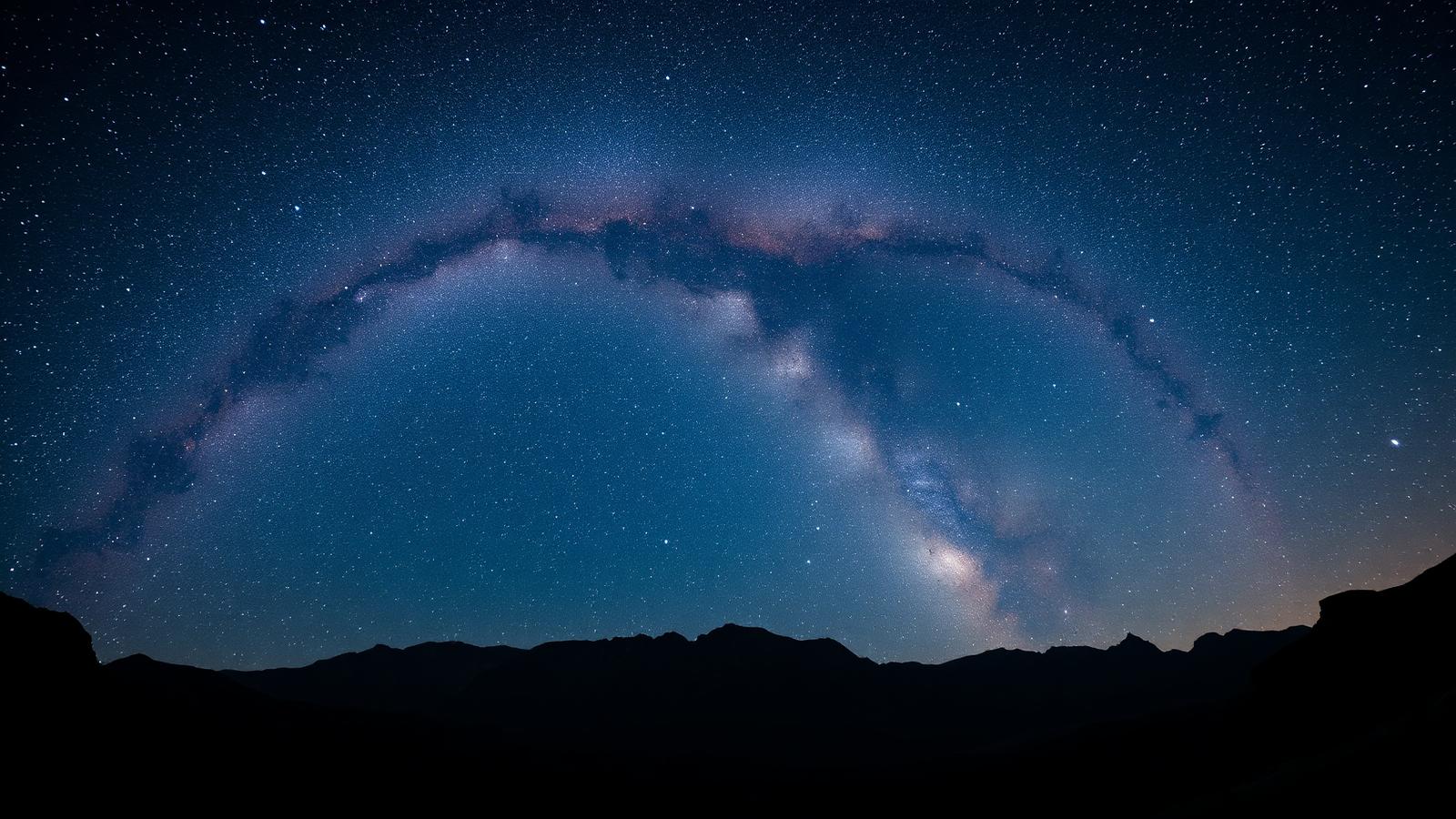
The Milky Way is a barred spiral galaxy about 100,000 light-years across, containing at least 100 billion stars. We live on one of its arms, about 26,000 light-years from the center. When you look at the bright band overhead you're looking along the disk from the inside — the concentration of stars, dust and gas that our arm sits within.
The brightest patch — the galactic core — is a dense bulge around a supermassive black hole called Sagittarius A*, roughly four million times the mass of the Sun. You can't see the black hole itself, but you can see the star clouds that surround it, the dark dust lanes that carve the band into shapes, and famous nebulae like the Lagoon and Trifid embedded in the arm.
For the naked eye, the Milky Way isn't an object — it's the sky. Once you've seen it properly from a dark site, the flat, empty sky of a city never quite looks the same again.
This month
How Milky Way visibility changes through the year
The galactic core is a seasonal object. Your latitude decides which months of the year it climbs high enough for a real view.
The galactic core is a seasonal object, and the season that matters is set by your latitude. From mid-northern latitudes it is a late-spring to early-autumn target, low in the south; from the southern hemisphere it passes overhead and is spectacular for far more of the year. Set a location and this section becomes a month-by-month account for your own sky.
Common mistakes
Why people fail to see the Milky Way
Every one of these is fixable. Most people give up on the wrong night, in the wrong place, or looking at the wrong thing.
- Trying from the backyard.
- 80% of North America and 60% of Europe live under skies where the galactic band is invisible to the naked eye. You cannot fix this with patience, camera settings, or averted vision — only distance. A 40–60 minute drive to a Bortle 4 site changes everything.
- Going out at the wrong time of year.
- The bright galactic core is a summer-through-early-autumn object in the northern hemisphere. From November to February the core is below the horizon during dark hours — only the fainter winter Milky Way in Cygnus and Cassiopeia remains. Check the "peak altitude" table above before you plan a drive.
- Underestimating the Moon.
- Any moon above the horizon brighter than about 30% will drown the fainter regions. First-quarter is not "dark enough" — it's a Milky Way killer. Plan for the week around new moon, or the interval after moonset on a gibbous night.
- Not letting eyes adapt.
- Full dark adaptation takes 20–30 minutes and a single glance at a phone resets it. Set brightness to minimum with a red filter, or leave the phone in the car.
- Bringing a telescope.
- A telescope narrows your view — precisely the wrong tool for a huge, low-contrast object. Naked eye or wide-angle binoculars is what you want. Save the telescope for the planets.
- Confusing a camera view with an eye view.
- A 20-second exposure at ISO 6400 always shows more than your eye ever will. If you've only seen the Milky Way in photos, calibrate: expect a soft, milky band with structure — not the saturated pinks and blues of a Nikon file.
Frequently asked questions
Related
Keep exploring tonight's sky
Tonight's sky guide
Sunset, twilight, moonrise and darkness times for your location.
Moon tonight
Phase, illumination and rise/set times for your location.
Planets tonight
Which planets are visible after sunset and before dawn.
Meteor showers tonight
Active showers, peak dates and effective rates for your sky.
ISS passes tonight
Live pass times with direction and altitude for your location.