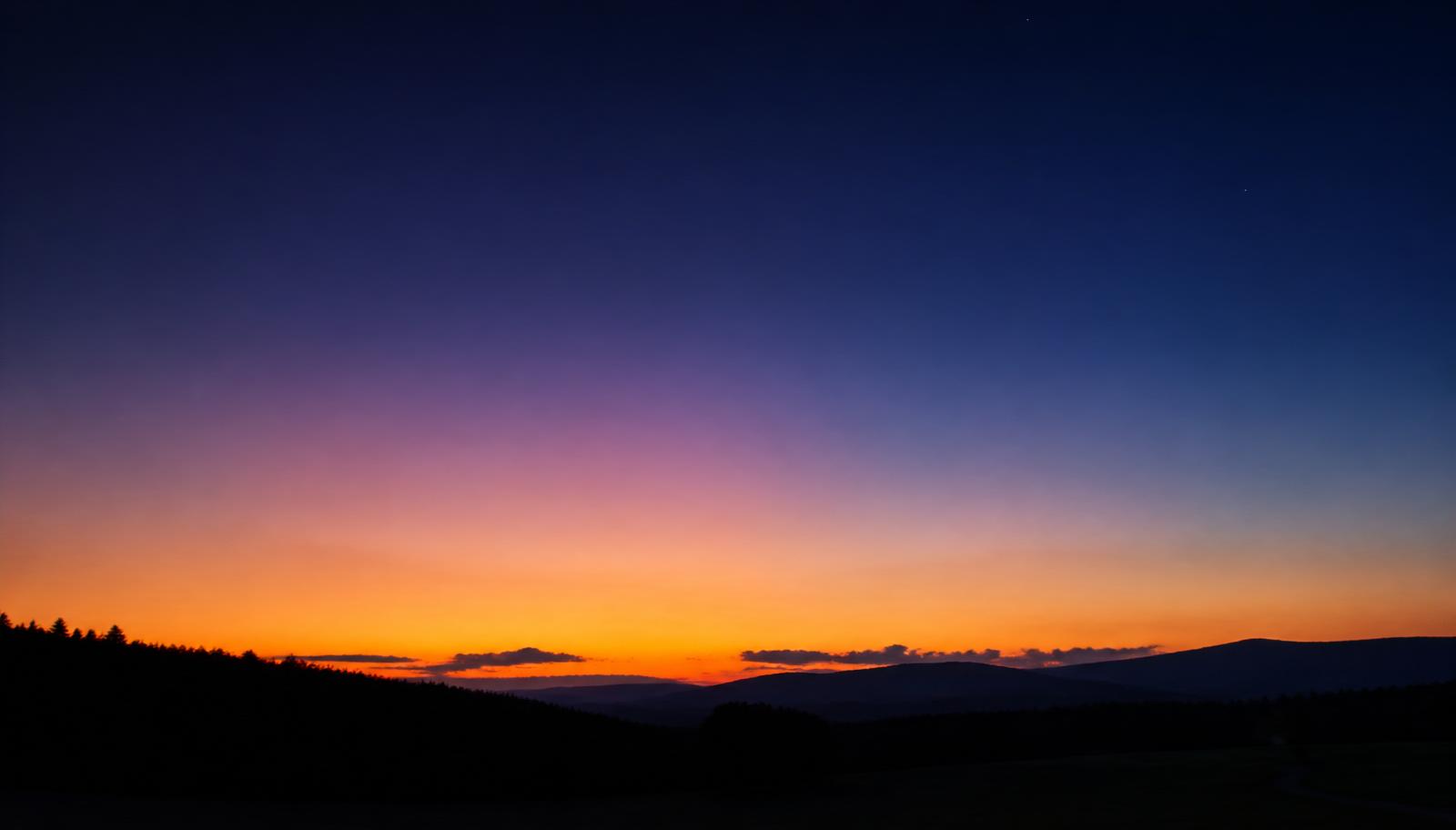
Sunset, twilight and darkness
Darkness has no single clock time — it depends entirely on your latitude and today's date.
What time does it get dark tonight?
Sunset, civil, nautical and astronomical dusk each arrive at different times depending on where you are on Earth. Set your location below and this page computes tonight's exact sequence for you.
Today's geometry · Monday 19 October
Why there is no single time it gets dark
The Sun's declination today is -9.8°, which fixes how steeply it drops below every horizon on Earth. Above 80° S it does not set at all. Everywhere else, darkness arrives in four stages — and the gap between them stretches with latitude.
Sunset
Sun 0°
The Sun's upper limb touches the horizon. Golden hour ends, blue hour begins.
Civil dusk
Sun −6°
Streetlights come on. Venus, Jupiter and the brightest stars appear.
Nautical dusk
Sun −12°
The sea horizon fades. Most naked-eye constellations are out.
Astronomical dark
Sun −18°
No sunlight reaches the upper atmosphere. Milky Way and faint meteors.
| Reference latitude | Sunset | Civil dusk | Nautical dusk | Astronomical dark | Sunset → dark |
|---|---|---|---|---|---|
| Equator (0°) | 17:48 | 18:12 | 18:37 | 19:01 | 73 min |
| 20° N | 17:34 | 18:00 | 18:25 | 18:51 | 77 min |
| 40° N | 17:16 | 17:47 | 18:18 | 18:50 | 94 min |
| 50° N | 17:02 | 17:40 | 18:17 | 18:54 | 111 min |
| 60° N | 16:42 | 17:30 | 18:18 | 19:06 | 143 min |
| 35° S | 18:17 | 18:47 | 19:18 | 19:50 | 93 min |
The stage definitions and the Sun's declination are global. Your own sunset, blue hour and the minute astronomical darkness begins depend on your latitude, longitude and time zone, so SnapCosmos computes them only for a location you actually give it — one tap below.
Location not set
Set a location for tonight's darkness time
Twilight length is a function of latitude and date. The same clock time is full darkness in one place and a bright sky in another.
- Sunset and the end of each twilight stage
- When astronomical darkness begins
- Whether it gets fully dark at all tonight
- How long the dark window lasts
Your choice stays in this browser. Nothing is sent to a SnapCosmos server.
Read
'Dark' has three definitions — all correct
Which one you care about depends on what you're trying to do.
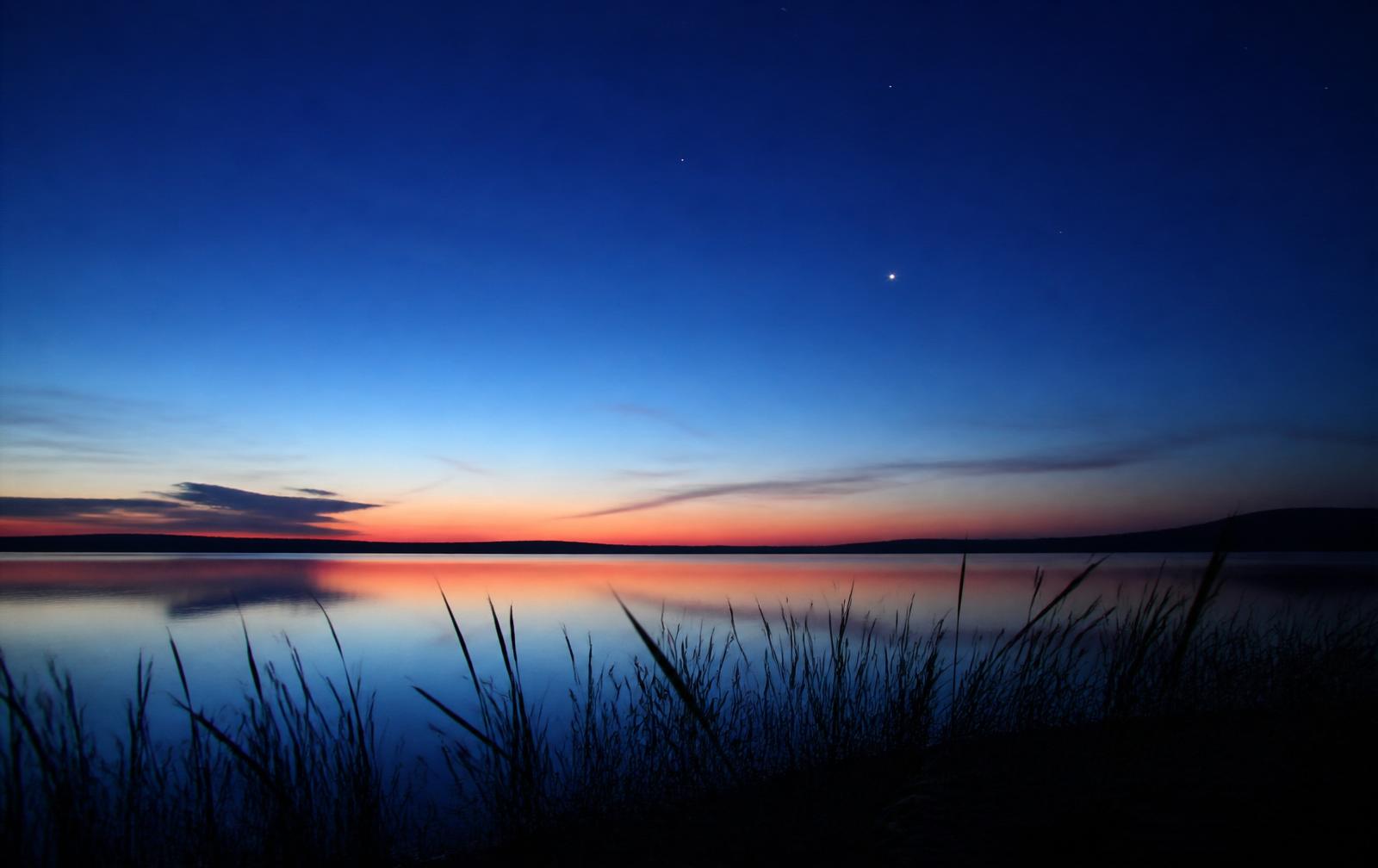
Nautical twilight — the blue hour has ended, the horizon has faded, and the first bright stars have arrived.
Civil twilight ends when the Sun is 6° below the horizon. This is the boundary where you start needing headlights on the road and streetlights come on automatically. The sky is a saturated blue — photographers call this the blue hour. You can already see Venus, Jupiter and the brightest handful of stars.
Nautical twilight ends at 12° below. Historically this was the point where the horizon at sea became indistinguishable from the sky — sailors could no longer use a sextant to fix stars against it. From land, this is when most of the naked-eye constellations are visible.
Astronomical twilight ends at 18° below. Only then is no sunlight reaching the upper atmosphere. This is what astronomers, aurora hunters and Milky Way photographers mean by dark. Faint meteors, weak aurora and deep-sky objects need this level of darkness to be seen properly.
At high latitudes in summer, astronomical night never happens — the Sun stays too shallow below the horizon for the sky to blacken. Norwegian summer nights are famously pale for this exact reason. It is not a defect; it is geometry.
After dark
What real astronomical darkness looks like
Once the Sun is 18° below the horizon, there is no residual sunlight in the sky. What you see instead is airglow — a permanent, faint greenish glow from oxygen and nitrogen molecules in the upper atmosphere — plus zodiacal light along the ecliptic, and, from a dark enough site, the full arch of the Milky Way stretching from horizon to horizon.
This is when meteor showers become worth staying up for, when aurora can be seen at lower activity levels, and when the faintest deep-sky objects — nebulae, distant galaxies, comets — reveal themselves. It is also when your eye's own dark adaptation reaches its full sensitivity, roughly 30 minutes after the last bright light.
Even the darkest astronomical night is not black. It is deep charcoal, textured, alive. The stars are unignorable. It is worth arranging your night around, if your latitude allows it.
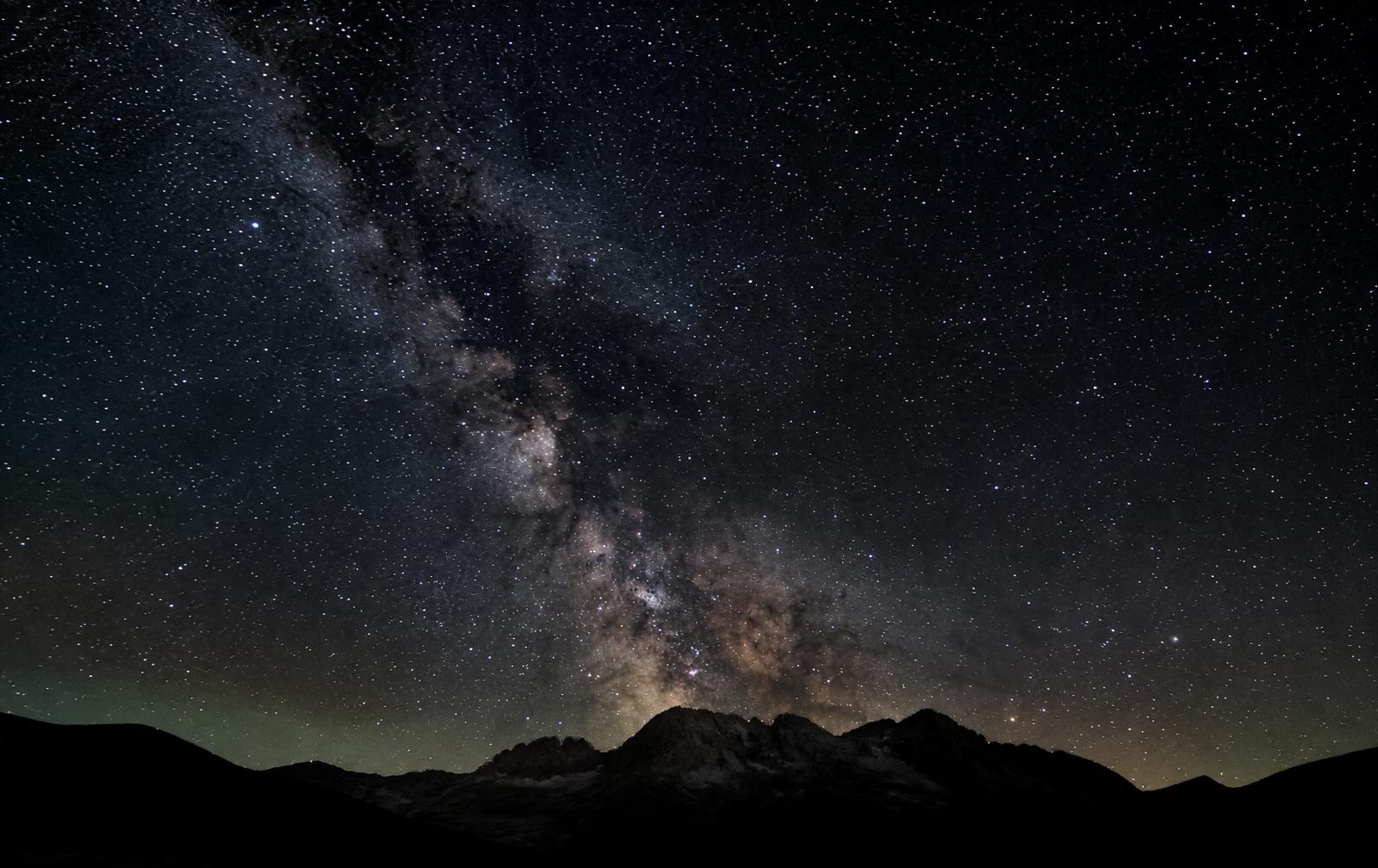
Astronomical night — Sun 18° below the horizon, no light pollution. The Milky Way is unignorable.
Frequently asked questions
Keep exploring