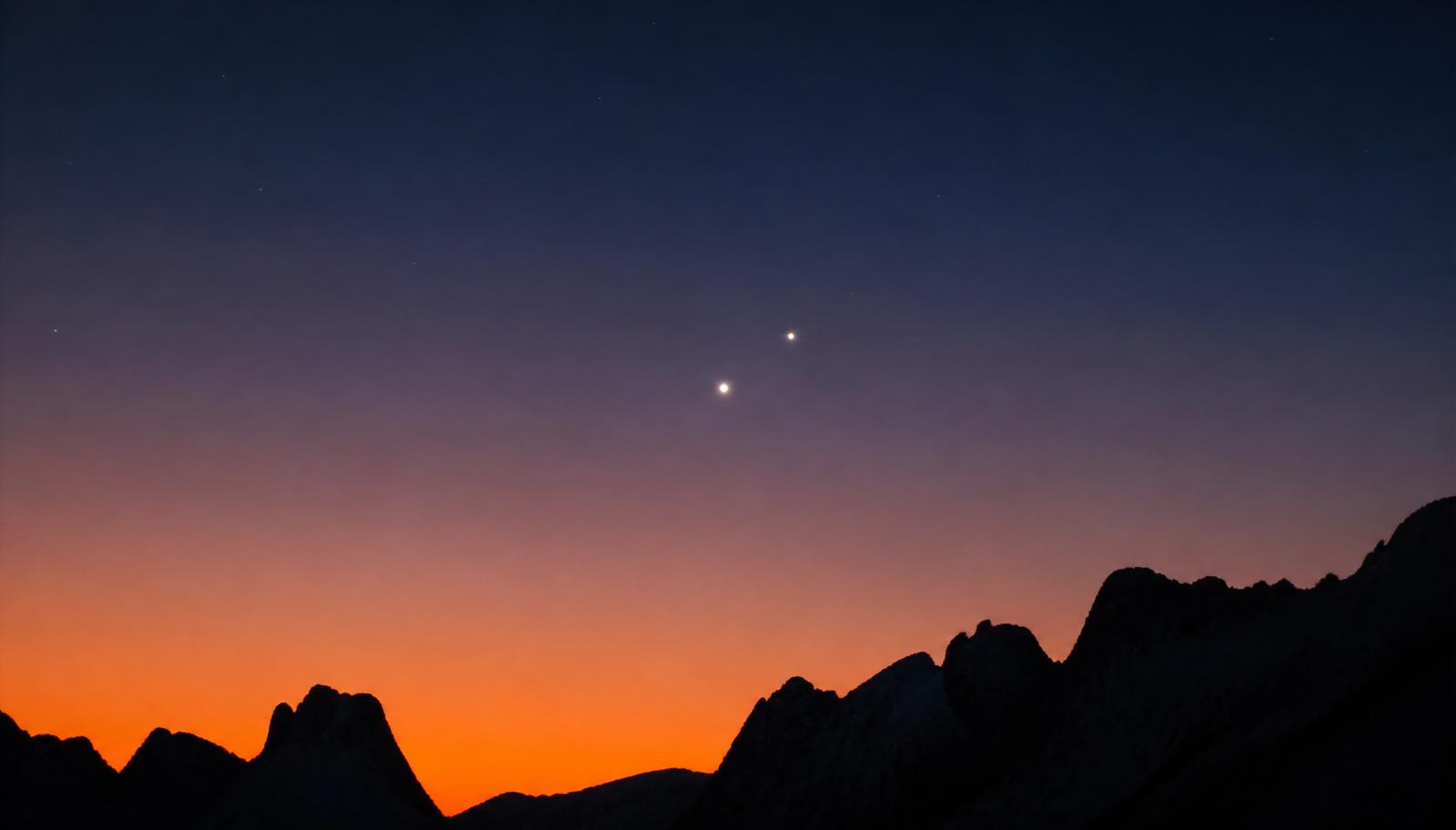
Conjunctions and planetary alignments
Moon and Venus sit within 2.9° of each other — a close pairing worth stepping outside for.
Moon meets Venus tonight
Tonight the pair is too low or below the horizon from your location. Better nights are coming — check back tomorrow.
- Closest pair
- Moon · Venus
- Separation
- 2.9°
- Best altitude
- -7°
- Parade planets
- —
Location not set
Set a location for tonight's alignments
Which planets pair up is the same for everyone tonight; whether that pair is above your horizon in the dark is not.
- Tonight's closest bright pairing
- Altitude, direction and best time
- Every visible pairing ranked
- Cloud cover for the window
Your choice stays in this browser. Nothing is sent to a SnapCosmos server.
Pair by pair
Every bright pairing in tonight's sky
Every combination of the Moon and the five naked-eye planets, ranked by how close they sit along the ecliptic tonight. Under 3° is a conjunction; under 1° is genuinely tight.
| Pair | Separation | Type |
|---|---|---|
| ☾Moon·♀Venus | 2.9° | Conjunction |
| ♀Venus·♄Saturn | 10.8° | Wide |
| ☾Moon·♄Saturn | 13.7° | Wide |
| ♂Mars·♃Jupiter | 38.4° | Wide |
| ☿Mercury·♄Saturn | 47.9° | Wide |
| ☿Mercury·♀Venus | 58.7° | Wide |
| ☾Moon·☿Mercury | 61.7° | Wide |
| ☾Moon·♂Mars | 69.0° | Wide |
| ♀Venus·♂Mars | 71.9° | Wide |
| ♂Mars·♄Saturn | 82.8° | Wide |
| ☾Moon·♃Jupiter | 107.4° | Wide |
| ♀Venus·♃Jupiter | 110.3° | Wide |
Read
What people actually mean by 'planets aligning'
The phrase carries a lot of mysticism it doesn't deserve. Here's the sober version.
When you read "the planets are aligning tonight," the writer almost never means what the phrase literally says. The planets are not queueing up in a straight line in three-dimensional space — they orbit at wildly different distances from the Sun on planes that don't quite match. A real physical alignment of even four planets to within a fraction of a degree in space happens on a timescale of millennia, not weeks.
What is happening, and what makes the phrase useful, is the projected alignment: from Earth's point of view, several planets are sitting on nearly the same line of sight along a slim strip of sky. That strip has a name — the ecliptic — and it's the same invisible arc the Sun traces during the day. All the naked-eye planets hug it because they all orbit close to the same plane.
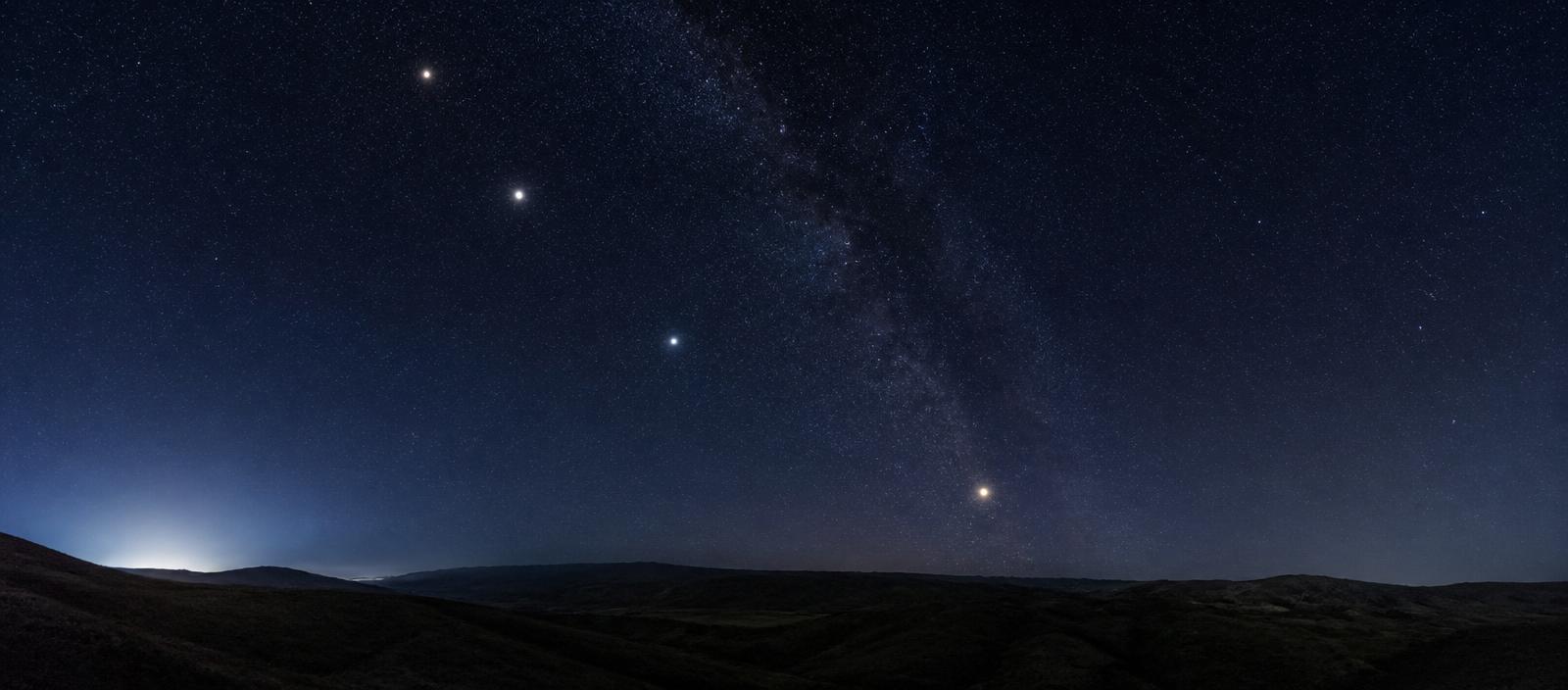
A "planet parade" is a projected alignment — several planets sharing the ecliptic from our line of sight, not a physical line-up in space.
When two planets share the same ecliptic longitude to within a degree or two, that's a conjunction. When three or more naked-eye planets sit inside a 30–40° window, that's what everyone — astronomers, headlines and TikTok — will call a planet parade or alignment. Both are wonderful sights. Neither is dangerous, neither triggers earthquakes, and neither is astrologically meaningful. They are simply orbital geometry doing its job.
Tonight the tightest pairing from your location is Moon and Venus, sitting 2.9° apart. No planet parade is under way — the naked-eye planets are spread too widely around the ecliptic tonight.
Also worth watching
Moon-planet conjunctions — the easiest naked-eye event
The Moon sweeps past each planet roughly once a month, and the Moon is bright and unmistakable. That makes Moon-planet conjunctions the most beginner-friendly night sky event: if you can see the Moon, you can see the meeting. A thin crescent Moon next to Venus in twilight is one of the most photographed sights in astronomy, and it is a genuinely graceful thing to witness — the Moon's dark side often lit by Earthshine, sunlight bounced off our own oceans.
Watch for how the Moon appears to "slide" from one side of the planet to the other over successive nights. That apparent motion is roughly 12° per day along the ecliptic — you're watching orbital mechanics in real time, with nothing more than your eyes.
For deeper timing and Moon phase details, see tonight's Moon page and the current standings of the naked-eye planets on the planets page.
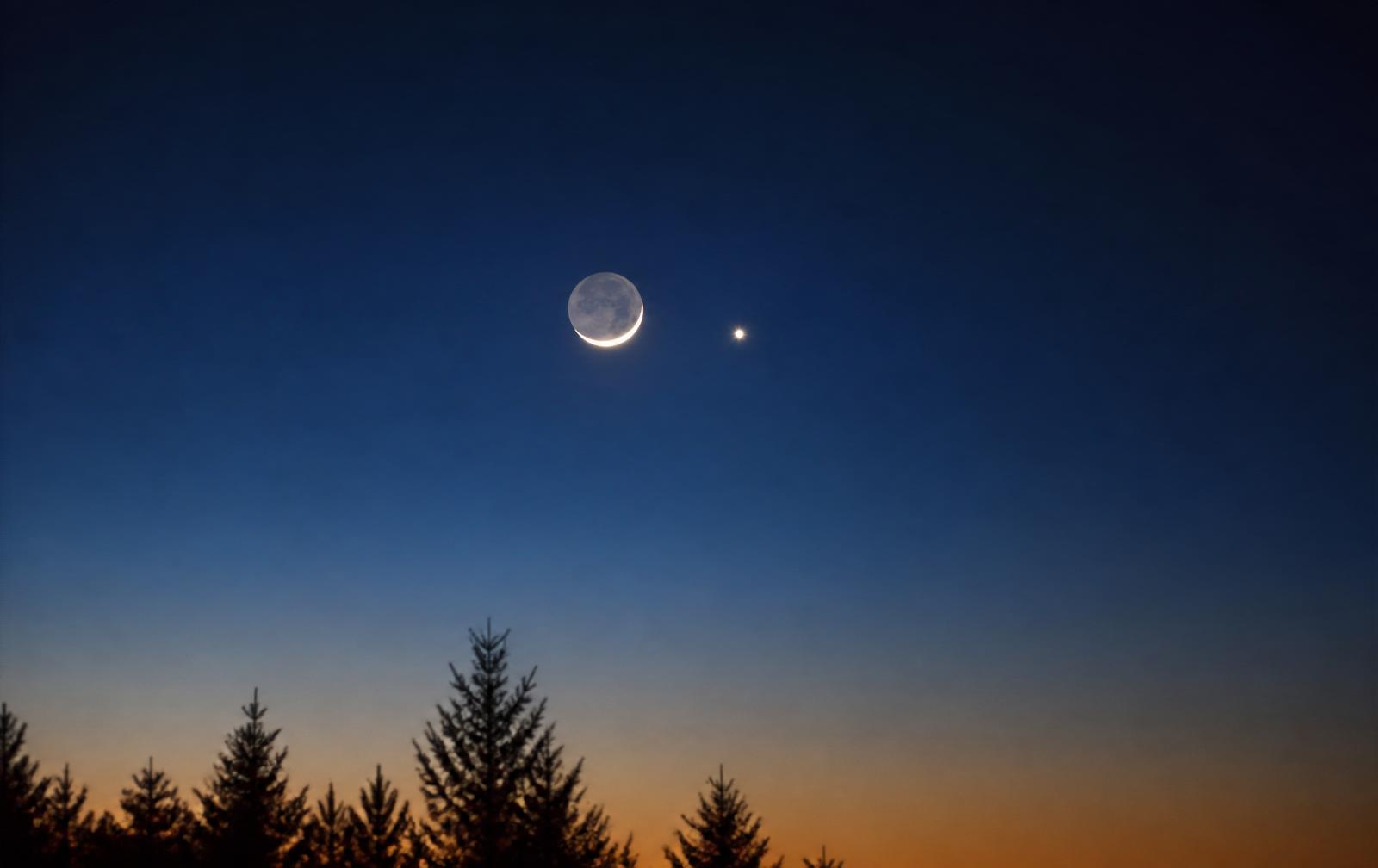
A crescent Moon and Venus in twilight — the classic naked-eye conjunction, with Earthshine visible on the Moon's dark side.
What's next
The next tight conjunction
Moon meets Venus on Monday, October 19, coming within 2.91°. That's tight enough to see them as a single close pair without any optical aid.
This page updates every night — bookmark it and check back the evening of the event for a full local read of altitude, direction and cloud cover.
Frequently asked questions
Keep exploring