How to spot the International Space Station from your backyard
The ISS is the third-brightest object in the sky after the Sun and Moon. Here's how to catch a pass tonight — no telescope required.
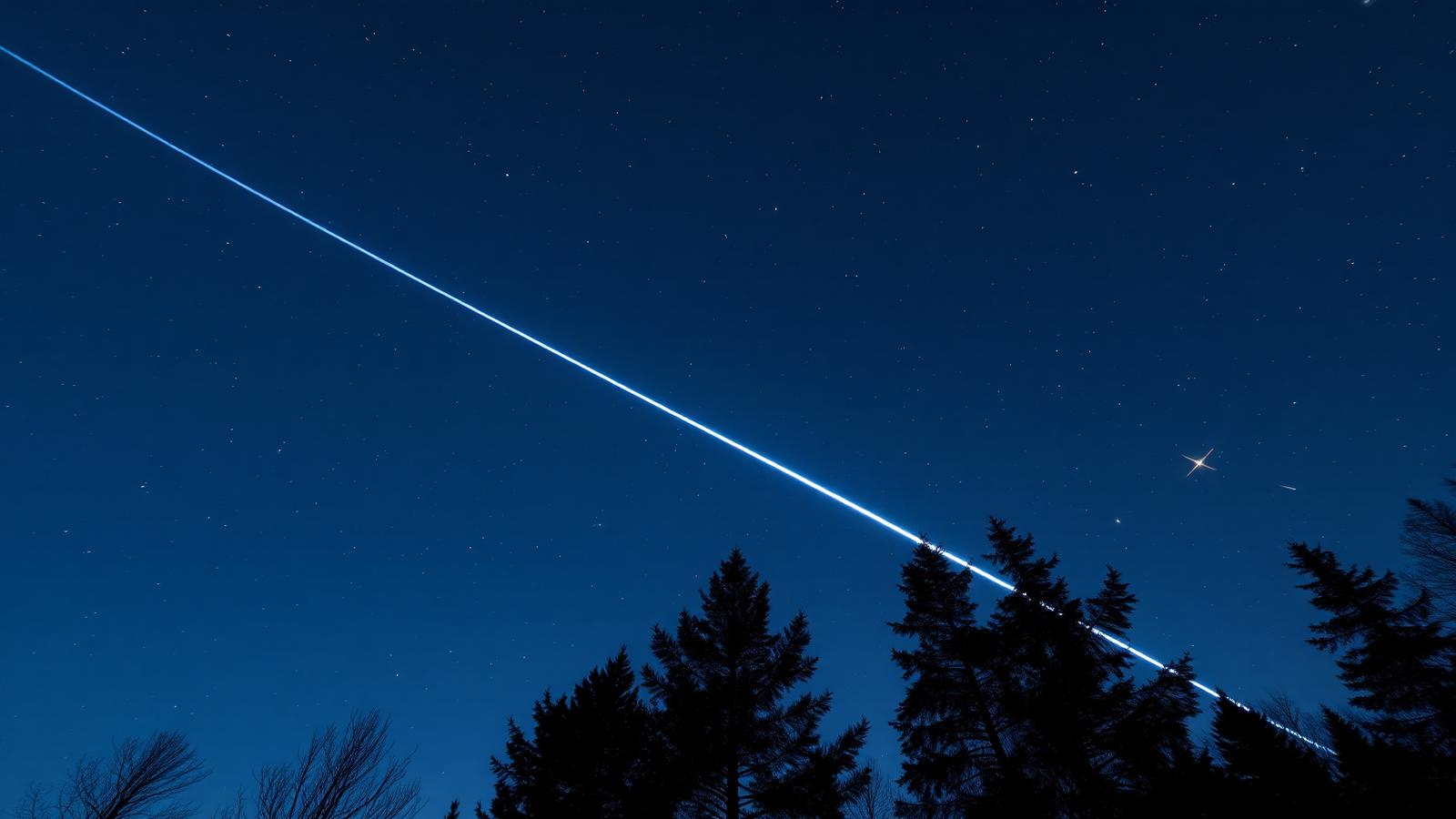
The International Space Station orbits Earth once every 92 minutes at an altitude of roughly 400 kilometres. It's the size of an American football field, its solar panels cover more than 2,500 square metres, and those panels reflect a surprising amount of sunlight straight back at us. When conditions are right, the ISS becomes the third-brightest object in the entire night sky — outshone only by the Sun and the Moon, and easily brighter than any planet or star. It moves smoothly, silently, and unmistakably: no blinking lights, no engine sound, no navigation strobes. Just a bright white dot gliding across the stars for two to five minutes, then fading out like someone slowly turned down a dimmer.
Once you've seen a good ISS pass, you never mistake anything else for it. And with a bit of planning, they're available almost every week from almost anywhere on Earth. This guide covers exactly how.
Why the ISS is visible at all
The ISS is not lit from within. What you're seeing is sunlight bouncing off its metallic hull and, especially, its huge photovoltaic arrays. That means passes are only visible when three things line up:
The station is above your horizon. Its orbit is inclined 51.6° to the equator, so it passes over most inhabited parts of the world. Latitudes above about 60° N/S get fewer overhead passes and more low ones.
The station is in sunlight. Even though it's night at ground level, at 400 km up the station can still be lit by the Sun.
You are in darkness or twilight. If the sky above you is bright, you won't see even a bright satellite against it.
Together, these conditions restrict good passes to a window of roughly 1–2 hours after sunset or 1–2 hours before sunrise, when your local sky is dark but the station is still above the terminator (Earth's day/night line) at altitude. In the middle of the night, the ISS is usually eclipsed by Earth's shadow and invisible even when it's overhead.
Reading a pass prediction
Every pass has three key numbers you should learn to read.
Start time and end time — when the station rises above your horizon and when it sets or enters Earth's shadow. A typical visible pass lasts 2–6 minutes.
Maximum altitude — how high it climbs above your horizon at the pass's peak, measured in degrees. Zero is on the horizon, 90° is straight up. Passes below about 30° max altitude are dim and often blocked by trees or buildings; passes over 60° are spectacular; passes over 80° are the "wow, that's incredibly bright" ones.
Direction — described as compass points, e.g. "appears NW, disappears SE." The ISS almost always travels roughly west-to-east, but the exact track shifts north or south depending on the geometry of that particular pass.
SnapCosmos's ISS page shows the next 10 days of visible passes from your exact location, with all three numbers plus a magnitude estimate. Anything brighter than magnitude −2 is a good pass. The best passes go down to −3.9, brighter than Jupiter.
How to actually watch a pass
Step outside two minutes before the predicted start. Face the "appears" direction, but keep your eyes moving around that quadrant of sky — the station rises where predicted, but exactly along which arc depends on your horizon.
Give your eyes a couple of minutes to adjust. You don't need full dark adaptation for the ISS (it's bright), but going straight from a phone screen to a dim horizon will make it hard to catch the first appearance.
At the predicted time, look for a bright, steady white "star" that wasn't there thirty seconds ago. It won't twinkle. Aircraft have flashing anti-collision strobes and coloured navigation lights; the ISS doesn't. If you see red or green flashes, it's a plane. If the light pulses regularly, it's a plane. If it's steady and moving smoothly across the sky, you've got it.
Watch it climb toward the point of maximum altitude, then descend to the "disappears" direction. Often it doesn't set on the horizon — instead it enters Earth's shadow mid-sky, fading from brilliant white to orange to red to invisible over about 30 seconds. This shadow-fade is a beautiful thing to witness once you know what it is: you're watching the station physically enter Earth's night side while you stand in it.
If you have binoculars, hand-holding while tracking a moving object is hard, but on a high pass you can catch a hint of the ISS's shape — a bright asymmetric cross rather than a point. Photographing it requires either a telescope on a motorised mount (for detail) or a wide lens with a 2–4 minute exposure (for the streak shown in the hero image).
Common look-alikes
Aircraft are the most common false positive. Rule of thumb: if you can hear it, it's not the ISS. If it has any flashing or coloured lights, it's not the ISS. If it's changing direction, it's not the ISS.
Iridium flares used to be famous — brief, bright flashes from the older-generation Iridium satellites — but the original constellation has been de-orbited and modern Iridium satellites don't produce them.
Starlink trains can be spectacular in the days immediately after a launch: a chain of a dozen or more evenly spaced satellites moving together across the sky. Within a few weeks they spread out and become individual, dim satellites. See our Starlink page for current spotting predictions.
The Hubble Space Telescope, the Chinese Tiangong space station, and various satellites can produce bright passes too. Tiangong is currently around magnitude −1 to −2 on the best passes, roughly a third as bright as the ISS but still very obvious. SnapCosmos flags these where relevant.
The people inside
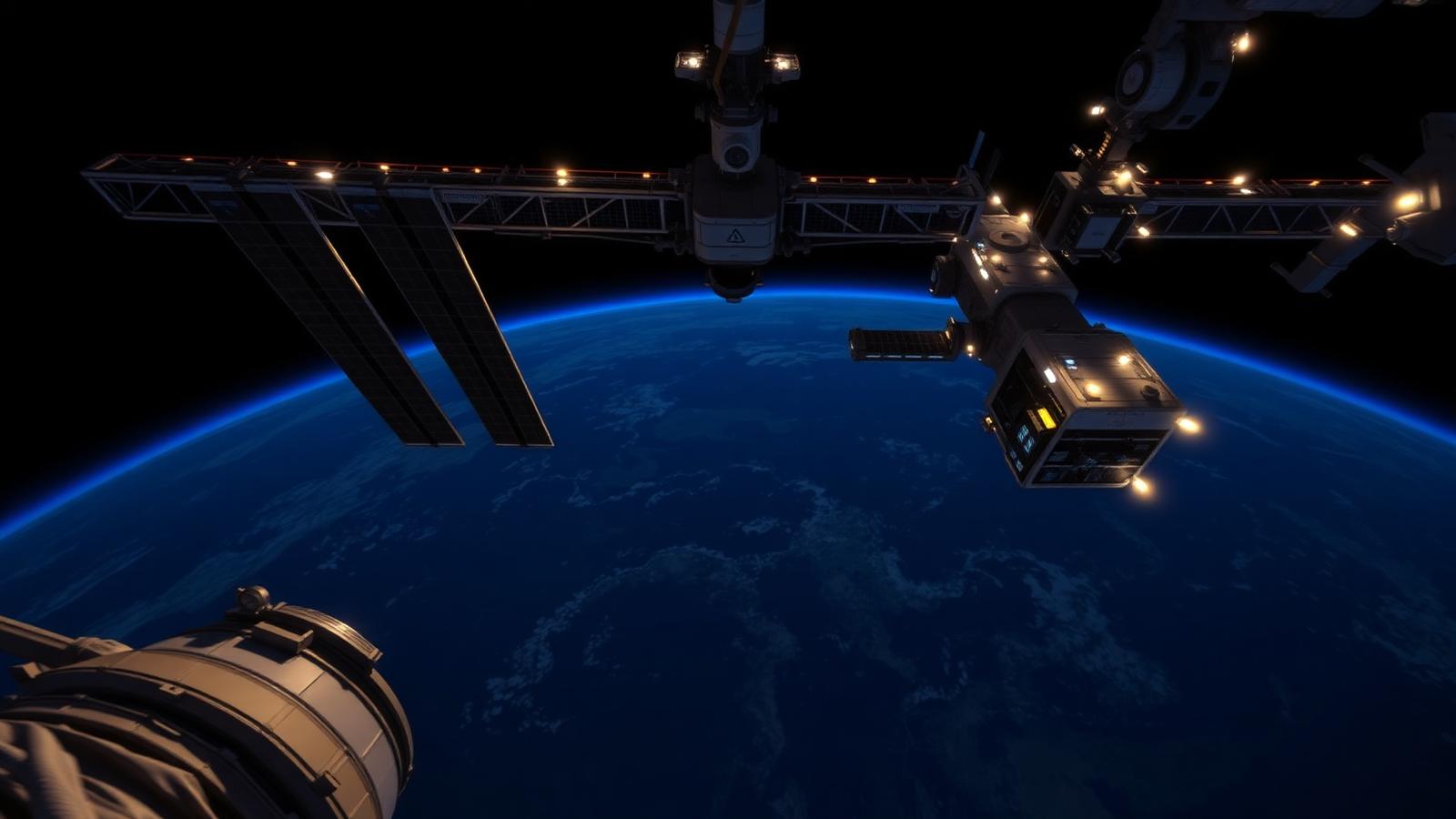
There have been continuous human occupants aboard the ISS since November 2000. Every time you watch a pass, there are typically 6–7 people inside — an international mix of NASA, Roscosmos, ESA, JAXA and CSA astronauts — moving at 27,600 km/h and orbiting Earth once every 92 minutes, seeing 16 sunrises and sunsets per day. When you wave at the ISS as it goes overhead, someone is above you doing science, eating dinner, or sleeping through your night. It's a small thing to wave. Many astronauts have described the moment they realise a country full of people is looking up as one of the strangest and most humbling parts of the job.
Best passes of the year
The station's orbital plane precesses (rotates around Earth's axis) with a period of about 63 days, so the visibility pattern from any given city cycles through: two-week windows of good evening passes, two-week windows of good morning passes, and gaps in between. Around each solstice, higher-latitude sites get long "seasons" of near-continuous visibility because the station's orbit stays partly in sunlight throughout your local night — sometimes producing three or four visible passes per night. Around the equinoxes at high latitudes, visibility drops off entirely for a couple of weeks.
The ISS is scheduled to be de-orbited in 2030–2031 and replaced by commercial space stations already in development. That's a real deadline. If you've never watched it fly over your house, this is a good decade to start.
Editorial note
Quantitative claims on this page — dates, magnitudes, distances, times — are based on primary sources (NASA/JPL, NOAA SWPC, ESA, IAU, or peer-reviewed literature). Where relevant they're linked inline so you can check them yourself. Spot a mistake? Email snapcosmosplus@gmail.com and we'll correct it. See the editorial policy for sourcing and corrections.
Keep reading
Beginner · 8 min
How to tell planets from stars with the naked eye
Two simple tests separate wanderers from fixed stars — plus how to identify Venus, Jupiter, Mars and Saturn without a chart.
Beginner · 8 min
Dark-adapt your eyes for real stargazing
Your eyes need 20–30 minutes of true darkness to unlock the faint sky. Here's the biology, the habits, and the mistakes that reset it.
Guides · 11 min
How to see the Milky Way with your own eyes
A practical, field-tested guide to spotting our galaxy — where to go, when to look, and how to actually see the galactic core with the naked eye.