Moon phases, simply explained (and why they're not Earth's shadow)
Why the Moon changes shape night after night, what a supermoon really is, and how to remember which phase is waxing, waning, gibbous or crescent.
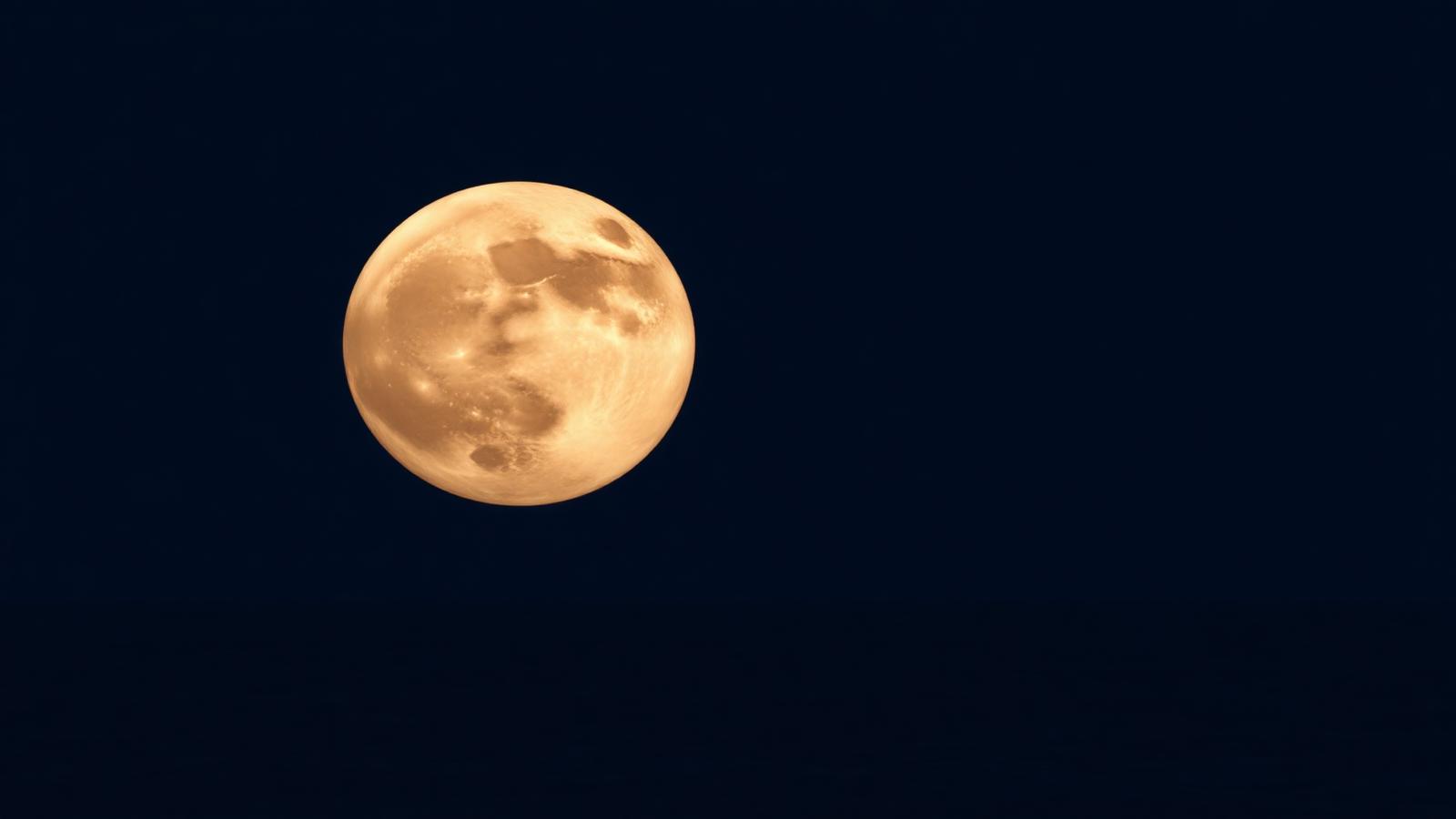
The Moon changes shape every night, on a schedule you can predict a thousand years in advance. But ask ten people why, and half will tell you it's Earth's shadow. It isn't. Understanding what's actually happening is one of those small mental shifts that suddenly makes the entire night sky make sense — including eclipses, tides, why the Moon is sometimes visible in the daytime, and why the crescent Moon always looks like it's smiling at the Sun.
This explainer walks through the geometry with no jargon, covers the eight named phases, explains supermoons and blood Moons, and gives you a memory trick that works for life.
The one sentence that explains everything
The Moon always shows the same face to Earth, and the Sun always lights half of the Moon. What changes is our viewing angle.
That's it. Every phase, every apparent shape, is just Earth watching a half-lit ball from a different position in the ball's orbit. If you could sit still above the North Pole and watch the Moon go round Earth, you'd see the same lit hemisphere pointing at the Sun at all times. From Earth's surface, though, we see it from the side, from behind, and from every angle in between — and the visible slice of the lit half changes accordingly.
The eight phases, in one sweep
The lunar cycle takes 29.53 days — the synodic month — and astronomers name eight positions along it. It's a smooth cycle, not a set of discrete stages, but the names are useful shorthand.
New Moon: the Moon sits between Earth and the Sun. Its lit side faces the Sun; the side pointing at us is dark. It rises with the Sun and sets with the Sun, so from Earth it's invisible in the glare — or, rarely, silhouetted as a solar eclipse.
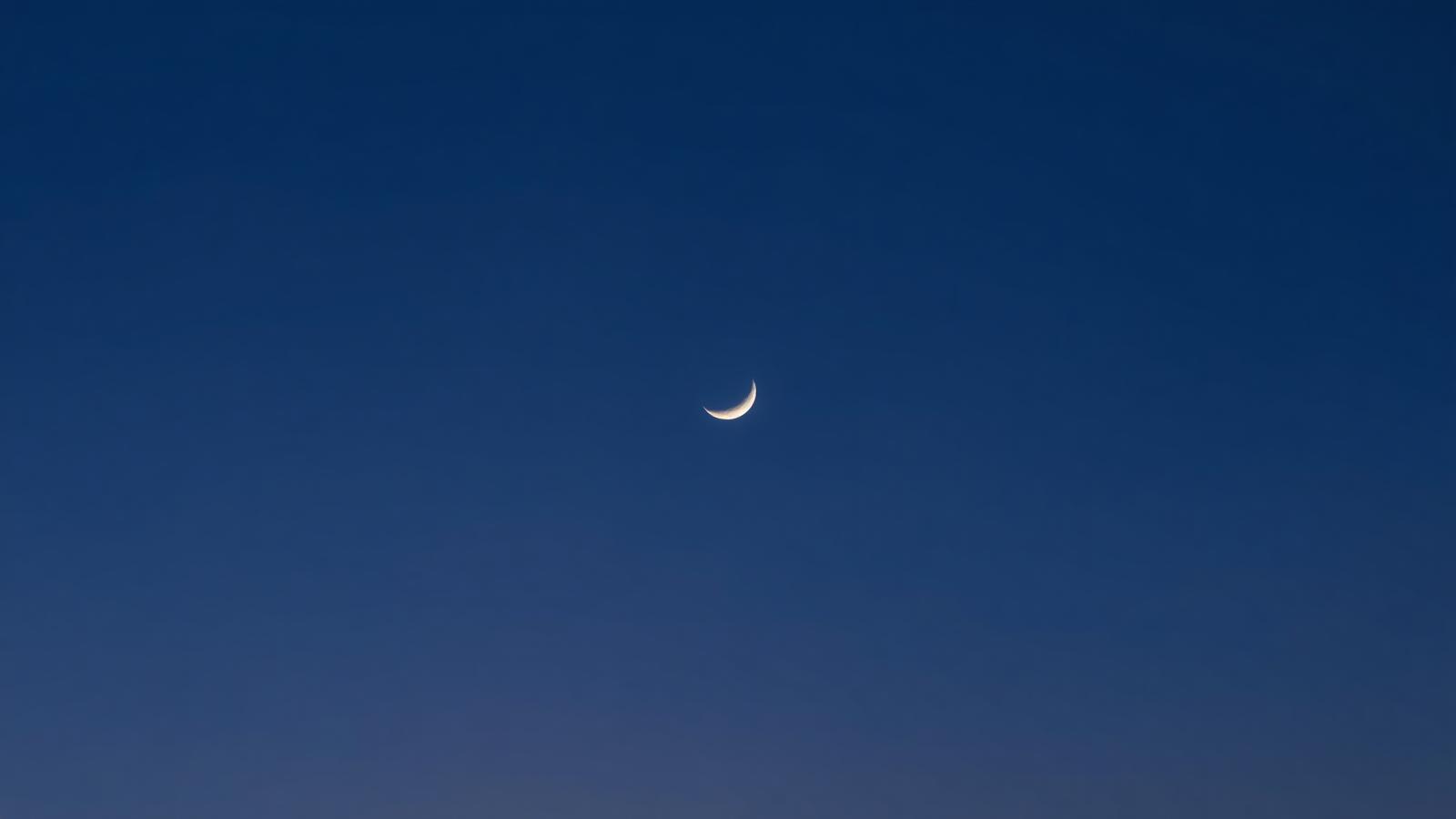
Waxing crescent: a day or two after new, a thin sliver of the lit side becomes visible in the western sky just after sunset. "Waxing" means growing.
First quarter: seven days in, we see exactly half the lit hemisphere. It's called "first quarter" because the Moon has completed one-quarter of its orbit. It rises around noon, transits at sunset, and sets around midnight.
Waxing gibbous: more than half but less than full. "Gibbous" is an old word meaning "hunchbacked" — the fat side.
Full Moon: Earth sits between the Sun and Moon. The entire lit hemisphere faces us. It rises at sunset, transits at midnight, sets at sunrise. This is the only phase that's up all night.
Waning gibbous: past full, shrinking. Rises after sunset.
Last (third) quarter: half-lit again, but the other half is lit compared to first quarter. Rises around midnight, transits at sunrise. This is the phase early risers see in the daytime sky.
Waning crescent: a thin sliver in the eastern sky before sunrise.
Then back to new, and the cycle repeats.
The trick to reading a Moon at a glance
Which way the crescent points, and which side is lit, tells you exactly where the Moon is in its cycle. The lit side always faces the Sun. If the right side is lit (in the northern hemisphere) and the crescent is small, the Sun is to the right of the Moon and has just set — so it's a waxing crescent shortly after new. If the left side is lit at dawn, the Sun is to the left, rising — so it's a waning crescent shortly before new.
A memory trick that works forever: in the northern hemisphere, imagine the Moon's terminator (the day-night line) as the vertical stroke of a letter. A waxing Moon looks like a lowercase D (right side lit). A waning Moon looks like a C (left side lit). "D grows, C shrinks." In the southern hemisphere everything's flipped, and D and C swap roles.
The daytime Moon
The Moon is above the horizon roughly half the time, but around new Moon it's up in the daytime and drowned out by the Sun. Around first quarter you can see it in the afternoon sky as a pale white shape. Around last quarter you can see it in the morning sky. Full Moon is the only phase that's up when the Sun is down and vice versa, so the "full Moon at midnight" association is wired deeply into culture — but the other phases are just as often daytime objects.
Eclipses: when it really is a shadow
Normally the Moon's orbit is tilted about 5° relative to Earth's orbit around the Sun. That's why we don't get an eclipse every new Moon (the Moon usually passes above or below the Sun in our sky) or every full Moon. But roughly twice a year the alignment is close enough that the shadows connect.
Solar eclipse: the Moon passes directly in front of the Sun, at new Moon. From a narrow track on Earth's surface the Sun is completely blocked (total eclipse); from a wider area it's partially blocked. Total solar eclipses are geometrically improbable — the Sun is 400 times bigger than the Moon and 400 times farther away, so they appear almost the same size in our sky. It's a coincidence, and it won't last forever: the Moon is drifting away from Earth at about 3.8 cm per year, and total eclipses will become impossible in about 600 million years.
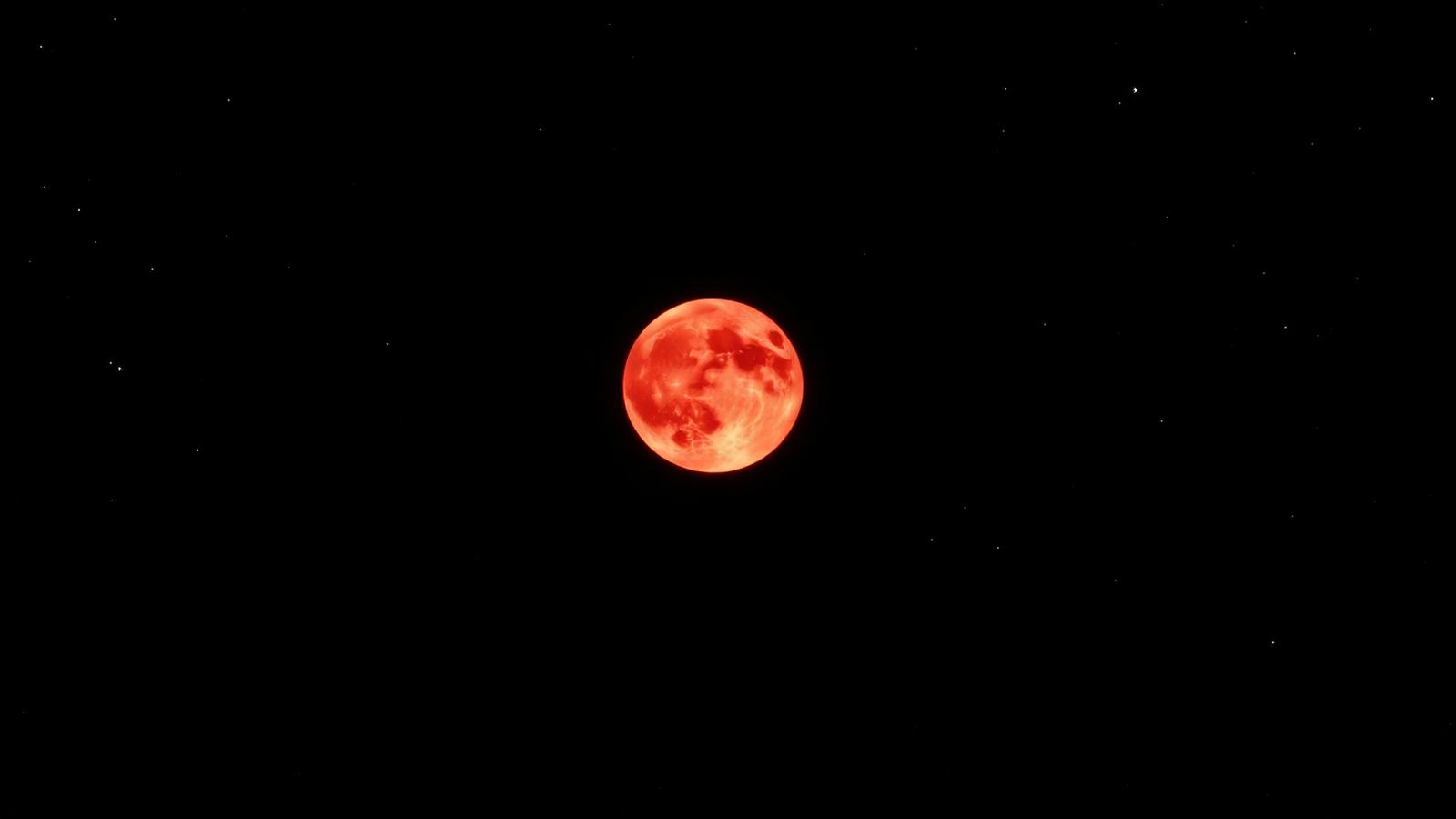
Lunar eclipse: Earth's shadow falls on the Moon, at full Moon. The whole night side of Earth sees it (unlike solar eclipses, which need you in the shadow track), and it lasts hours instead of minutes. The Moon usually turns a deep red-orange during totality — hence "blood Moon" — because Earth's atmosphere refracts sunset light onto the Moon's surface. If you were standing on the Moon during a lunar eclipse, you'd see Earth blocking the Sun, ringed by every sunset and sunrise on Earth happening at once.
Supermoons, blood Moons and other headlines
"Supermoon" is a modern marketing term for a full Moon that happens near lunar perigee — the closest point in the Moon's slightly elliptical orbit. A supermoon looks about 7% larger and 15% brighter than an average full Moon. It's a real effect, and it's noticeably brighter, but the size difference is essentially invisible to the naked eye without a side-by-side comparison. Photographs of "huge supermoons" almost always use compressed telephoto perspective to make the Moon appear enormous behind a horizon subject; you'd get the same effect on any Moon.
The "Moon illusion" is the opposite: a rising Moon near the horizon looks huge, then appears to shrink as it climbs. Its actual angular size doesn't change (measure it — it's the same width your little fingernail covers at arm's length). Something about the presence of horizon reference points fools our brain into perceiving it as larger. The effect has been documented since ancient Greece and there's still no universally agreed explanation.
Traditional Moon names — "Wolf Moon," "Harvest Moon," "Strawberry Moon" — come from Indigenous North American, colonial and European seasonal traditions and refer to the full Moon of each month. They're evocative but astronomically unremarkable; every full Moon is a full Moon.
Why the Moon has no dark side
Every part of the Moon gets sunlight over a lunar day (about 29.5 Earth days). What you sometimes hear called "the dark side of the Moon" is the far side — the hemisphere we never see from Earth, because the Moon is tidally locked and always shows us the same face. But the far side gets exactly as much sunlight as the near side, on average. Pink Floyd knew this; the album title is a metaphor.
Tides
The Moon's gravity pulls harder on the near side of Earth than the far side, stretching the oceans into two bulges — one facing the Moon, one on the opposite side. As Earth rotates through the bulges we get two high tides and two low tides per day. When the Sun and Moon pull in the same line (new Moon and full Moon), the tides are extra large: spring tides. When they pull at right angles (first and last quarter), they partly cancel: neap tides. This is why the Moon's phase quietly affects fishing, sailing, coastal ecology and, once, entire civilisations.
Once you internalise the geometry, the night sky becomes readable. A crescent low in the west after sunset isn't just pretty — it tells you where the Sun is, where you are in the month, and roughly when the next new Moon will be. Look up tomorrow and check.
Editorial note
Quantitative claims on this page — dates, magnitudes, distances, times — are based on primary sources (NASA/JPL, NOAA SWPC, ESA, IAU, or peer-reviewed literature). Where relevant they're linked inline so you can check them yourself. Spot a mistake? Email snapcosmosplus@gmail.com and we'll correct it. See the editorial policy for sourcing and corrections.
Keep reading
Explainers · 10 min
The Bortle scale: how dark is your sky, really?
The 1–9 scale astronomers use to describe night-sky darkness, what you can see at each level, and how far you need to drive to escape city light.
Guides · 11 min
How to see the Milky Way with your own eyes
A practical, field-tested guide to spotting our galaxy — where to go, when to look, and how to actually see the galactic core with the naked eye.
Beginner · 8 min
How to spot the International Space Station from your backyard
The ISS is the third-brightest object in the sky after the Sun and Moon. Here's how to catch a pass tonight — no telescope required.