Your first pair of astronomy binoculars: what to buy and what to skip
Skip the telescope. A good pair of 10×50 binoculars will show you more, faster — and here's exactly what to look for and where to point them.
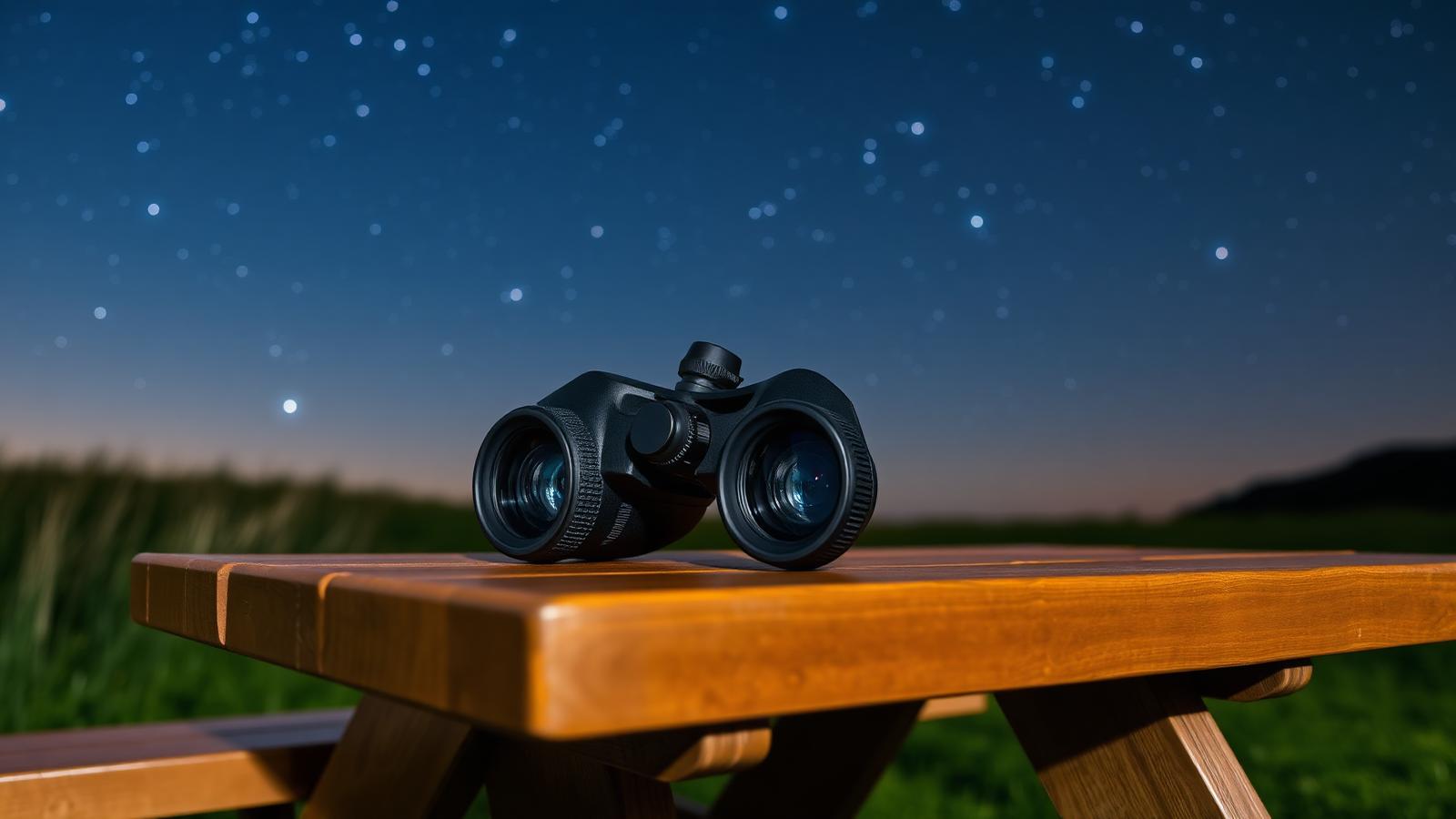
The most common piece of advice given to new astronomers is "buy a telescope." It is, most of the time, bad advice. A cheap telescope is a frustrating instrument — hard to set up, hard to point, hard to focus, hard to see anything through, and easy to give up on. A good telescope is expensive and requires a serious commitment to learning. Meanwhile, a moderately priced pair of astronomy binoculars will show you Jupiter's four largest moons, the craters along the lunar terminator, the Andromeda Galaxy, the Orion Nebula, the Pleiades, the Beehive Cluster, hundreds of double stars, and the Milky Way in resolvable star fields — all within a week of owning them.
This is a straight-talking guide to buying your first pair, understanding the numbers on the box, and knowing where to point them once you have them.
Reading the numbers: 10×50, 7×50, 15×70
Every pair of binoculars is labelled with two numbers separated by "×." The first is magnification; the second is the front lens (objective) diameter in millimetres. Both matter, but not for the reasons beginners assume.
Magnification is straightforward: 10× makes objects appear ten times closer. Higher magnification lets you resolve finer detail but also magnifies every wobble of your hands. Above about 12×, most people cannot hand-hold binoculars steady enough to enjoy the view — you need a tripod or a monopod. This is why 10× is the universal sweet spot for hand-held astronomy binoculars.
The objective diameter determines two things: light-gathering ability and the "exit pupil" — the beam of light that comes out of the eyepiece into your eye. Divide the objective by the magnification to get the exit pupil in millimetres. A 10×50 gives 5mm; a 7×50 gives 7mm; a 15×70 gives about 4.7mm.
Why exit pupil matters: the human eye's maximum pupil diameter under dark adaptation is about 7mm for a young adult, falling to 5mm or less by middle age. Any exit pupil larger than your eye's pupil is wasted — the extra light just hits your iris. So a 7×50 at 7mm is only ideal for a fully dark-adapted teenager; for most adult observers, 5mm (10×50) is a better match. This is why 10×50 has been the standard astronomy binocular size for decades.
The recommendation, in one line: for hand-held general-purpose astronomy, buy a pair of 10×50 with a wide field of view (6.5° or more), BAK-4 prisms, and fully multi-coated optics. Expect to pay somewhere in the range of €80–€200 for something that will outlast several telescopes.
What to skip: zoom binoculars (optical compromises), 20× or 25× hand-held (image will be uselessly shaky), tiny 8×25 travel binoculars (not enough light gathering), and image-stabilised binoculars for a first purchase (great instruments, but expensive and heavy for a first commitment).
If you have €300–€500 and want a permanent upgrade, look at 15×70 or 20×80 mounted on a lightweight tripod. These reach much fainter deep-sky objects and turn the Moon, Jupiter and the great globular clusters into stunning views. But they need a tripod, which is a separate commitment.
Prisms, coatings, and other technical asterisks
Two features actually matter on the box: prism type and coating type.
BAK-4 prisms are made of a high-quality barium-crown glass and produce a fully illuminated circular exit pupil. Cheaper BK-7 prisms are made of borosilicate and produce a squared-off exit pupil with dimmer edges. Difference at the eyepiece: modest but real. Pick BAK-4 if the price difference is under €30.
Fully multi-coated (FMC) optics have anti-reflection coatings on every single glass surface. "Multi-coated" (MC) means only some surfaces. "Coated" means only the outer surfaces. Uncoated is a red flag; do not buy. FMC preserves noticeably more light and contrast, particularly on faint deep-sky objects, and the price difference is usually small enough that FMC is worth it.
Beyond that, "roof prism" vs "porro prism" is mostly a shape/weight/price trade-off (porros are cheaper and often optically better at the same price point; roofs are more compact). Weather sealing is nice but not essential for astronomy. "ED glass" and other exotic materials reduce colour fringing at high magnifications but matter less at 10×.
Hand-holding steady: technique matters
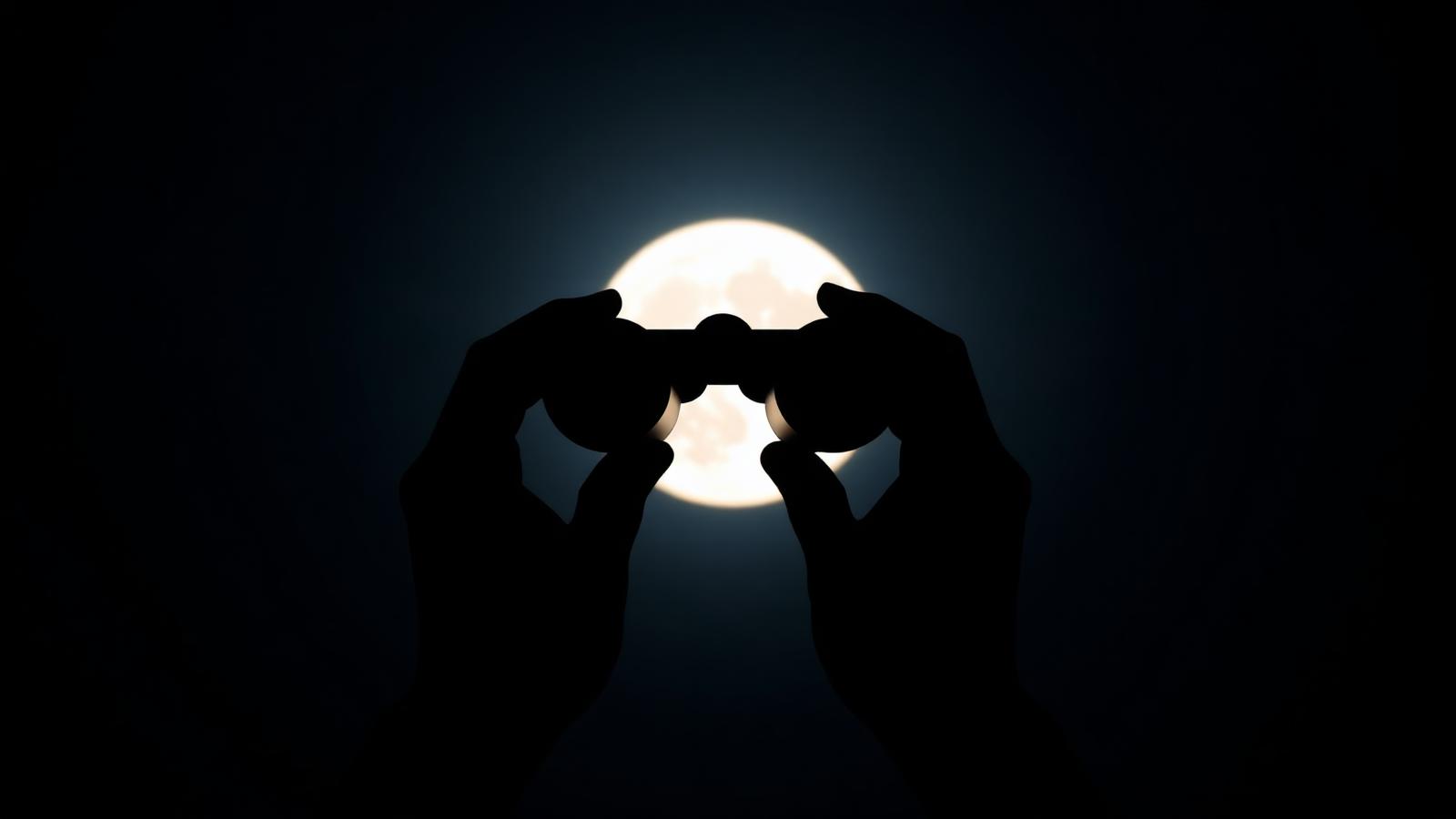
The single biggest complaint from new binocular owners is that "the image shakes too much." Almost always this is a technique problem, not an equipment problem. Three habits fix it:
Tuck your elbows into your ribs. Free-floating elbows produce a wobbly image no matter what binoculars you use. Anchor your arms to your torso and the image steadies immediately.
Lean against something. A wall, a fence, a tree, the corner of your house. Or lie on your back with the binoculars pointed straight up — this is actually the most comfortable way to observe overhead objects for extended periods, and the ground is a perfect stabiliser.
Breathe. Hold the binoculars up, exhale slowly, then take your observation during the natural still moment at the end of the exhalation. Snipers use the same trick. It's astonishing how much steadier the view becomes.
For anything above 12× or for extended observation, a tripod is transformative. A simple binocular-to-tripod adapter costs €10 and mounts most binoculars to any camera tripod.
First targets: what to look at
Start with the Moon. At 10× you can see individual craters, the great mare, and the mountainous rim of Copernicus. The best phases are first and last quarter, when shadows along the terminator make everything look three-dimensional. Full Moon is impressive for brightness but shadow-less. Never use binoculars to look at the Sun without proper filters — it's genuinely and permanently blinding.
Then Jupiter. Even in modest binoculars you can see four tiny "stars" strung out either side of the planet: the Galilean moons Io, Europa, Ganymede and Callisto. Their positions change from night to night as they orbit. Once you notice this you will look at Jupiter differently forever.
The Pleiades (M45, in Taurus). Naked-eye it looks like a fuzzy patch of six or seven stars; binoculars reveal a stunning open cluster of dozens of blue-white stars fitting perfectly in the field of view. Best from late autumn to early spring in the northern hemisphere.
The Andromeda Galaxy (M31, in Andromeda). The furthest thing most people can see with their unaided eye — 2.5 million light-years away — and it fills a substantial part of a binocular field. On a dark night you can trace it as an elongated oval rather than a fuzzy point.
The Orion Nebula (M42, in Orion). Below the three belt stars, a small "star" in Orion's sword is actually a nebula. Binoculars reveal a green-grey mist wrapped around a knot of newborn stars. Best from December to March.
The Beehive Cluster (M44, in Cancer) and the Double Cluster (in Perseus) are two more open clusters that look breathtaking in binoculars and disappointing in a telescope with too narrow a field of view. This is the great strength of binoculars: wide field of view.
Comets, when they appear, are best seen in binoculars — they're too big and diffuse for most telescopes, and too faint for the naked eye. Binoculars are ideal.
Where binoculars stop and telescopes start
There are real limits. To see Saturn's rings as anything more than a "flattened" look to the planet, you need a small telescope at 30× or more. To see cloud bands on Jupiter, same. To see the polar caps of Mars, more. Planetary observation is where telescopes justify themselves.
Deep-sky work has a similar cliff. The Ring Nebula (M57), the Whirlpool Galaxy (M51), globular clusters like M13 in Hercules — all of these are visible in binoculars as faint smudges, but a 4- to 8-inch telescope from a dark site turns them into real objects with structure. If you find yourself hitting the limits of binoculars and wanting more, a small refractor or a used 6-inch Dobsonian is a good next step.
But — and this is the point of this article — do not skip the binocular step. The observers who go straight to a telescope often quit within a year because they never learn the sky, never build the observing habit, and never enjoy the sky enough to justify the setup ritual. Binoculars are always ready to go. You grab them, walk outside, look up. Every clear night for the rest of your life is a chance to see something new.
Buy a decent pair. Take them out tomorrow night. Point them at the Moon. Everything else follows.
Editorial note
Quantitative claims on this page — dates, magnitudes, distances, times — are based on primary sources (NASA/JPL, NOAA SWPC, ESA, IAU, or peer-reviewed literature). Where relevant they're linked inline so you can check them yourself. Spot a mistake? Email snapcosmosplus@gmail.com and we'll correct it. See the editorial policy for sourcing and corrections.
Keep reading
Guides · 11 min
How to see the Milky Way with your own eyes
A practical, field-tested guide to spotting our galaxy — where to go, when to look, and how to actually see the galactic core with the naked eye.
Explainers · 9 min
Moon phases, simply explained (and why they're not Earth's shadow)
Why the Moon changes shape night after night, what a supermoon really is, and how to remember which phase is waxing, waning, gibbous or crescent.
Beginner · 8 min
How to spot the International Space Station from your backyard
The ISS is the third-brightest object in the sky after the Sun and Moon. Here's how to catch a pass tonight — no telescope required.