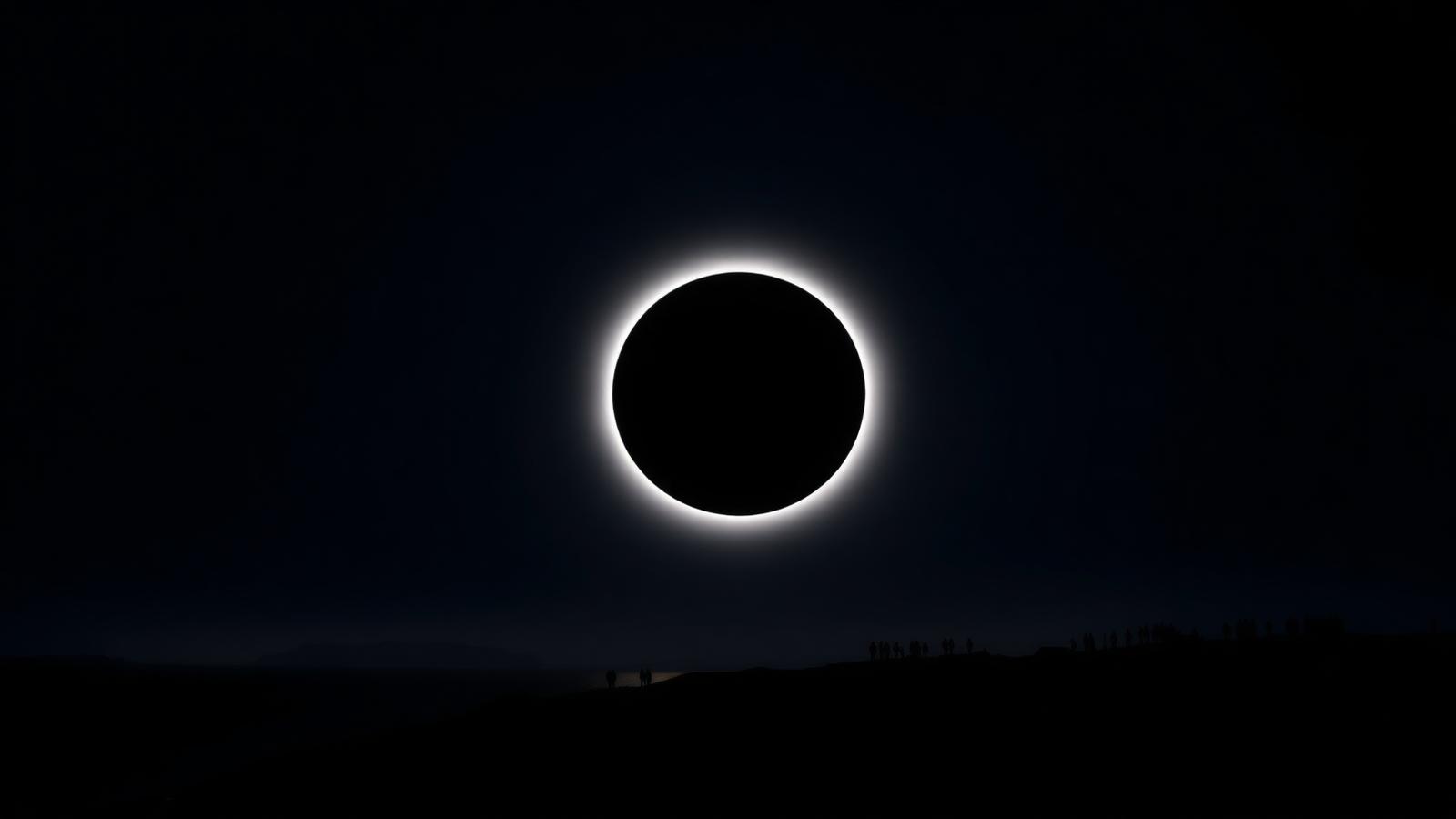
Solar eclipse · 12 August 2026
Europe's first total solar eclipse since 1999 — reachable by car for most of the continent.
Total Solar Eclipse — August 12, 2026
The Moon's umbral shadow crosses the Arctic, eastern Greenland, Iceland and northern Spain on Wednesday, 12 August 2026 — offering up to 2 minutes 18 seconds of totality, and a very deep partial for most of Europe. The last continental-European totality was in 1999.
- Date
- Aug 12
- Greatest eclipse
- 17:46 UT
- Max totality
- 2m 18s
- From here
- 83%
Location not set
Set a location to see your eclipse circumstances
The eclipse path is fixed; what you see depends entirely on where you stand — totality, a deep partial, or nothing at all.
- Whether you are inside the path of totality
- Obscuration percentage at maximum
- Start, maximum and end times locally
- Sun altitude during the eclipse
Your choice stays in this browser. Nothing is sent to a SnapCosmos server.
The path of totality
Iceland, the Atlantic, and northern Spain
The Moon's dark inner shadow — the umbra — traces a narrow band roughly 290 kilometres wide across the Earth's surface. Only observers inside that band see the Sun completely disappear. Everyone else sees only a partial eclipse, no matter how deep.
The 12 August 2026 shadow track begins at sunrise over the Russian Arctic, sweeps south-southwest over the North Atlantic and eastern Greenland, crosses western and northern Iceland in mid-afternoon local time, races down the Atlantic for two hours, and finally makes landfall in northwestern Spain in the hour before sunset — passing over Galicia, Asturias, Cantabria, La Rioja, Navarra, Aragón, southern Catalonia, northern Valencia and the Balearic Islands before ending at sunset near Mallorca.
Two aspects of this path are unusual and worth planning around. First, the Sun is very low over Spain: from Bilbao it is only 5° above the horizon at totality; from Zaragoza, 3°; from Valencia, less than 2°. An eclipse this low is spectacular — the corona hangs against a colored sky — but it demands a wide-open western horizon. Second, Iceland offers the highest Sun (18–22°) on land, but the reliably variable summer weather makes a fixed viewing plan risky. Mobility on eclipse day, either by car or by boat, is the standard advice from experienced eclipse chasers.
| City | Totality begins | Duration | Sun alt. |
|---|---|---|---|
| Reykjavík · Iceland | 17:48 GMT | ≈1m 05s | 22° |
| Ísafjörður · Iceland | 17:47 GMT | ≈2m 12s | 20° |
| A Coruña · Spain | 20:29 CEST | ≈1m 22s | 8° |
| Oviedo · Spain | 20:30 CEST | ≈1m 45s | 6° |
| Bilbao · Spain | 20:31 CEST | ≈1m 27s | 5° |
| Zaragoza · Spain | 20:33 CEST | ≈1m 43s | 3° |
| Palma de Mallorca · Spain | 20:36 CEST | ≈1m 26s | 1° |
| Valencia · Spain | 20:33 CEST | ≈0m 55s | 2° |
Local circumstances rounded from NASA GSFC and the IMCCE Eclipse Portal. Values on the central line; durations shorten toward the edge of the path.
What you see
A minute and a half you never forget
The partial phase lasts about 75 minutes on each side of totality and is, honestly, unremarkable until roughly 15 minutes before second contact. Then the light changes. The temperature drops. Colours desaturate. Shadows on the ground sharpen unnaturally, because the light source has become a thin crescent. If there are trees, the gaps between their leaves cast hundreds of tiny crescents on the ground — one of the most photographable moments of the whole eclipse.
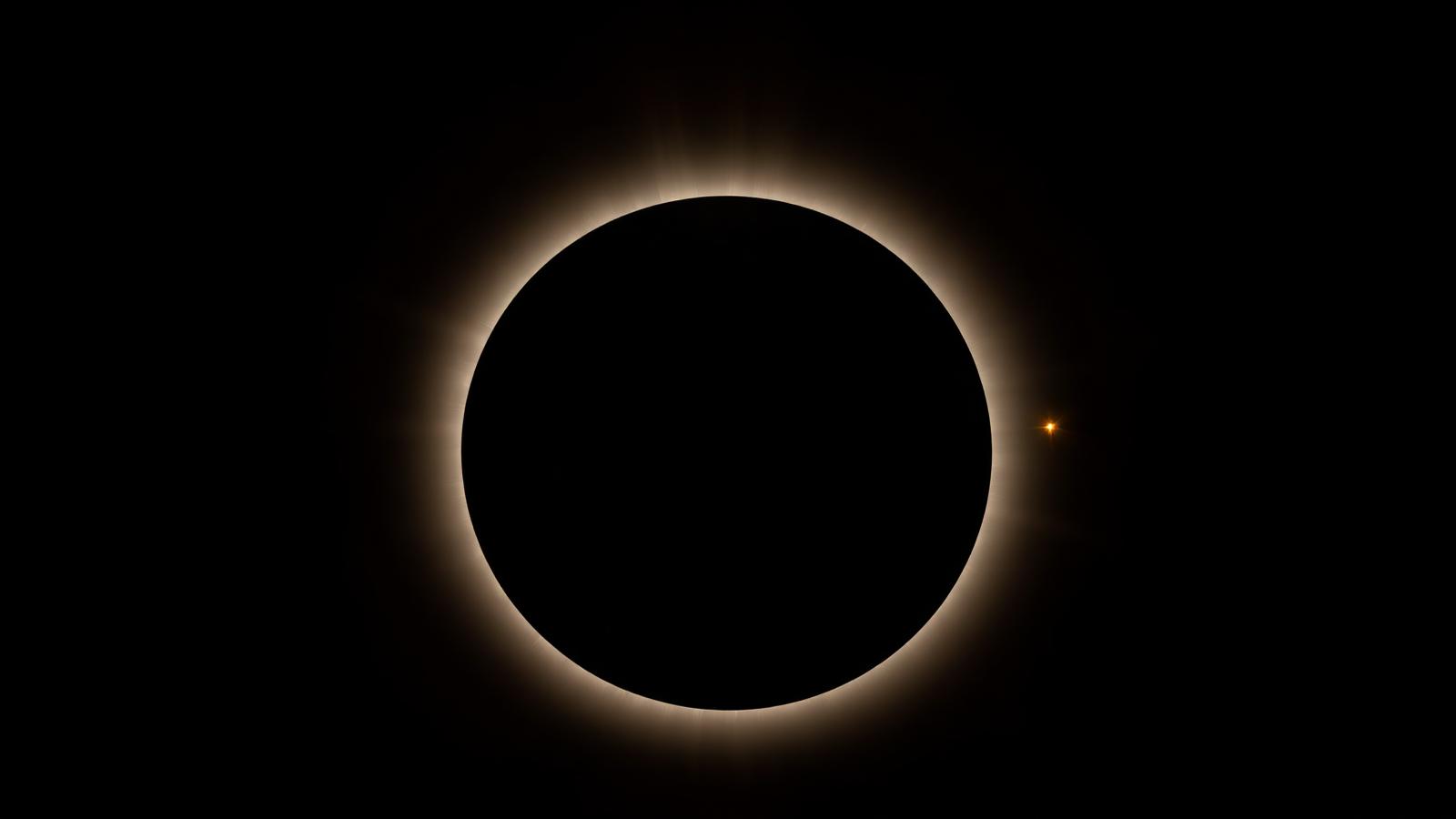
In the final seconds before totality, the last sliver of the Sun breaks into brilliant beads of light through valleys on the lunar limb — Baily's beads — then contracts to a single blazing point surrounded by the corona: the diamond ring. When the diamond disappears, the corona flares open, three-dimensional and structured, and the sky goes twilight-dark. Venus is easy to find; Jupiter, Mercury and Regulus may all appear within a fist's width of the eclipsed Sun.
Totality itself lasts, from most of Spain, between 55 and 105 seconds. Look around. The horizon glows 360° sunset-orange in every direction. Then, on the opposite limb, another diamond blazes — third contact — and you have less than a second to get your glasses back on.
Outside the path
A very deep partial for most of Europe
Even without travelling to Iceland or Spain, most of western Europe sees a spectacular partial eclipse in the late evening of 12 August.
| City | Max coverage | Local time |
|---|---|---|
| London, UK | 90% | 20:14 BST |
| Paris, France | 92% | 20:29 CEST |
| Amsterdam, Netherlands | 89% | 20:22 CEST |
| Berlin, Germany | 82% | 20:27 CEST |
| Oslo, Norway | 79% | 20:19 CEST |
| Copenhagen, Denmark | 82% | 20:22 CEST |
| Stockholm, Sweden | 74% | 20:23 CEST |
| Helsinki, Finland | 63% | 21:19 EEST |
| Rome, Italy | 76% | 20:31 CEST |
| Madrid, Spain | 99% | 20:31 CEST |
| Lisbon, Portugal | 97% | 19:26 WEST |
| New York, USA | 22% | 18:42 EDT |
| Boston, USA | 30% | 18:45 EDT |
| Reykjavík, Iceland | 100% | 17:48 GMT |
Approximate values at greatest local coverage. Certified eclipse glasses are required at every moment outside the path of totality — a 99% partial is still 10,000× too bright to view unfiltered.
Eye safety
ISO 12312-2 or nothing
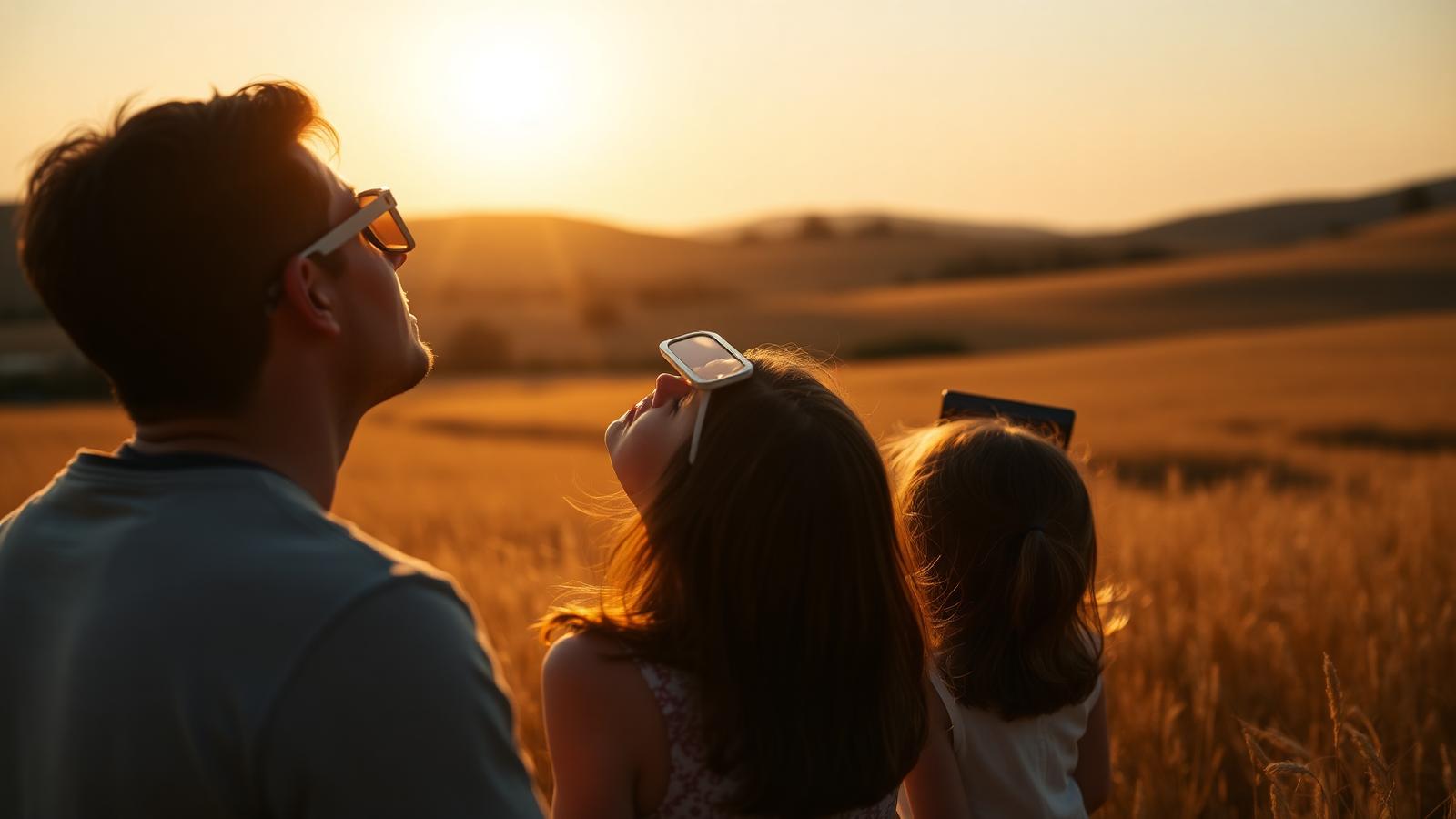
The only safe way to look at a partially eclipsed Sun is through solar filters that meet the international standard ISO 12312-2. Certified eclipse glasses cost a few euros; a good solar filter for a telescope or camera costs €30–€150. Every reputable supplier — AAS-listed brands such as American Paper Optics, Baader Planetarium, Thousand Oaks Optical, Solar Eclipse International — prints the standard on the product.
What does not work: sunglasses (even stacked pairs), exposed film, CDs, smoked glass, polarising filters, neutral-density photographic filters, welding glass below shade 14, or "just glancing quickly". The Sun does not hurt to look at because there are no pain receptors on the retina — you damage your vision without noticing, and the damage is often permanent. Children in particular need supervised glasses that fit.
The only moment when the naked eye is safe is during totality itself, from inside the path of totality. When the last bead of Sun disappears, the corona is roughly as bright as a full Moon and completely safe. The instant the first bead reappears — that final "diamond" on the opposite limb — glasses must go back on.
The same night · 12–13 August 2026
The Perseid meteor shower peaks the same night as the eclipse.
Solar eclipses only happen at New Moon — the exact condition that makes 2026's Perseid peak essentially moonless. If you're already under the eclipse path or its deep-partial zone, stay put: you'll see the corona at sunset and up to a hundred meteors per hour before dawn. →
Common questions
Frequently asked
Frequently asked questions
Related
Keep exploring
Perseid meteor shower 2026
A moonless Perseid peak the same night as the eclipse.
Sun — tonight
Sunrise, sunset, blue hour and civil twilight for your location.
Moon tonight
Phase, illumination and moonrise for your location.
What time does it get dark tonight?
Twilight and astronomical darkness times.
Planets tonight
Which planets are visible right now from your sky.
Tonight's sky
A full timeline of what's visible from your location tonight.
Sources: eclipse geometry and path from NASA GSFC Eclipse Web (Fred Espenak, Xavier Jubier). Local circumstances computed via astronomy-engine, using the same Meeus / JPL DE-4XX algorithms as NASA reference software. Path-city timings cross-checked against the IMCCE Eclipse Portal. See editorial policy for how quantitative claims are checked.