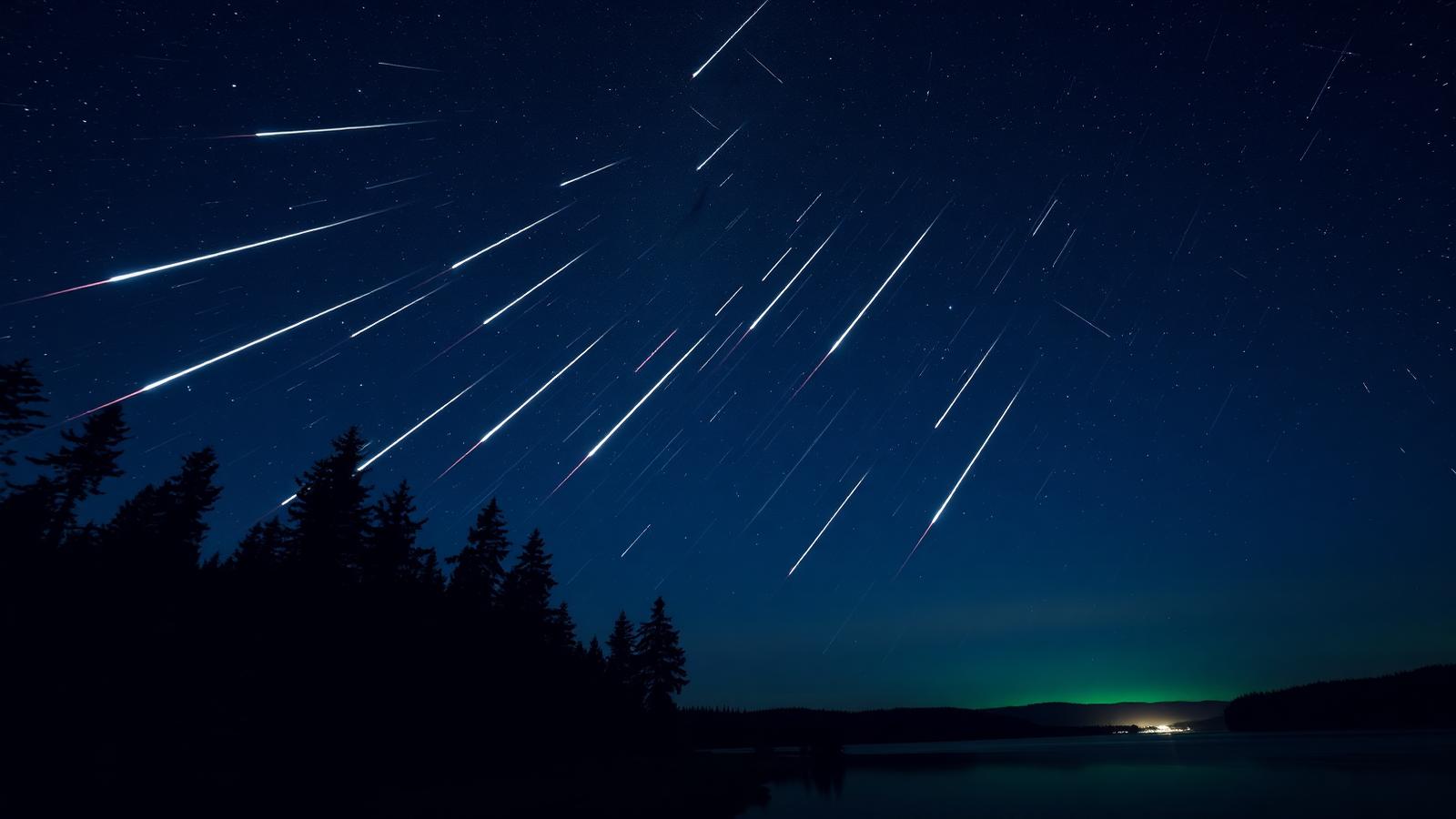
Meteor Shower · Perseids 2026
The Perseids: bright, fast, and this year, moonless at peak.
Perseid Meteor Shower 2026: Peak August 12–13, Moonless
Peak night is 12–13 August 2026, maximum around 06:00 UT on 13 August, and the best hours are local 02:00–04:00. New Moon falls on 12 August, so the sky stays properly dark from dusk to dawn. Look northeast to east, roughly halfway up the sky — meteors streak everywhere, but their trails point back to Perseus.
- Peak night
- Aug 13
- Peak ZHR
- ~100/hr
- Moon at peak
- 0%
- Nights to peak
- 67 past
Location not set
Set a location for tonight's Perseid verdict
The Perseid peak date is the same worldwide. How high the radiant climbs, when it is best and whether your sky is dark are not.
- Radiant altitude and compass bearing right now
- The best hour to be outside tonight
- Rates adjusted for your latitude and Moon
- Cloud cover for the peak window
Your choice stays in this browser. Nothing is sent to a SnapCosmos server.
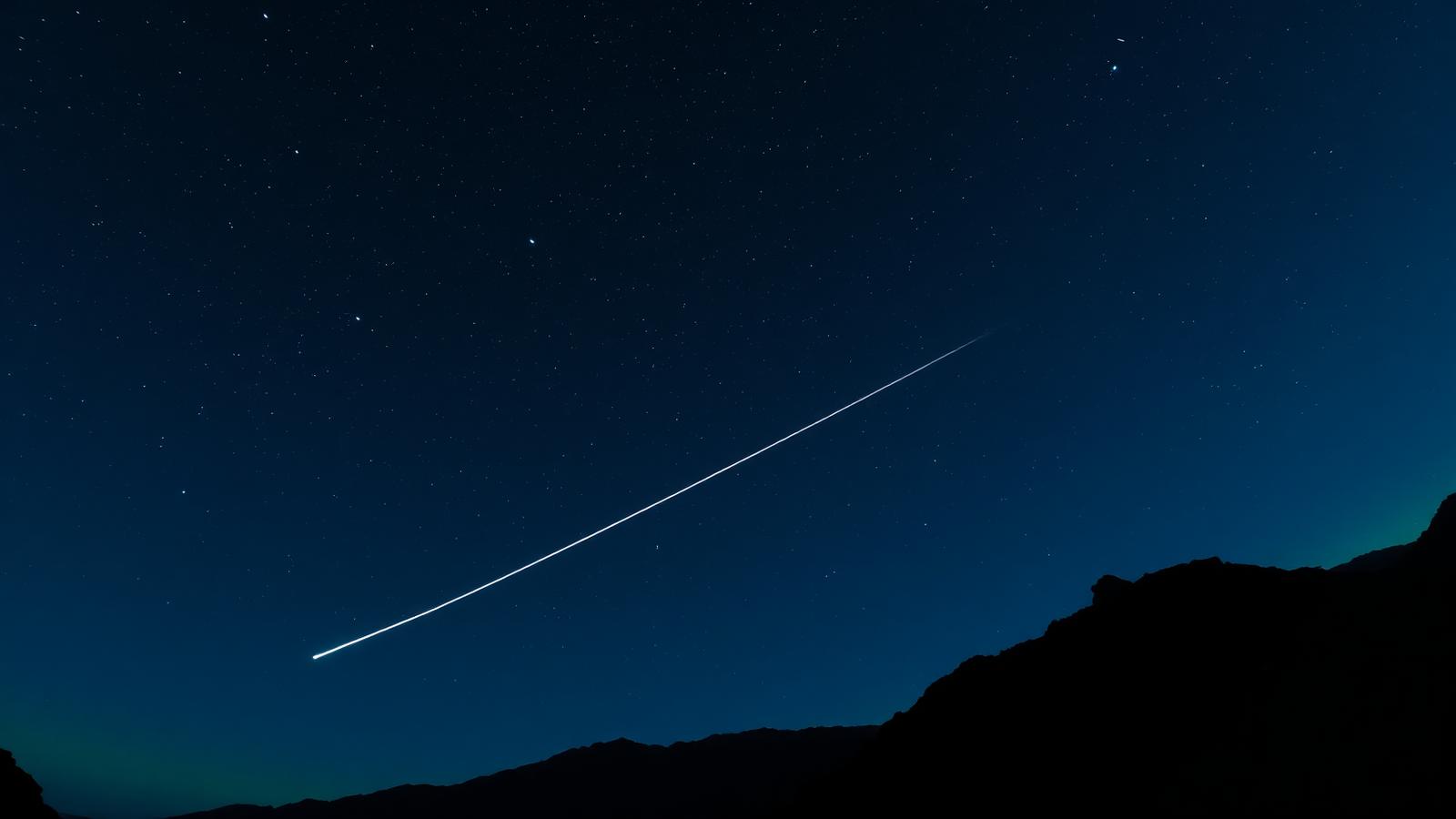
Why 2026 matters
A moonless Perseid peak — once in a decade
The single biggest variable in any meteor shower is the Moon. In 2026 it is completely on our side.
New Moon falls on 12 August 2026 at 17:37 UT — the same calendar day as the Perseid maximum. From sunset until sunrise on the peak night, the Moon is either invisibly close to the Sun or a thin waxing crescent that sets almost immediately after the Sun. For all practical purposes there is no moonlight in the sky.
This matters more than most people expect. A full or gibbous Moon during Perseid peak — the case in 2022, 2025, and again in 2028 — washes out about two-thirds of the visible meteors. In 2026 you see every faint streak you would otherwise lose. If you have ever been disappointed by a Perseid night, this is the year to try again.
The peak itself is forecast for approximately 06:00 UT on 13 August 2026, based on the International Meteor Organization's 2026 calendar. That timing favours observers across Europe, western Asia and western Africa, whose pre-dawn hours fall closest to the maximum. Observers in the Americas will do best in the hours before their local dawn on 12 August (early peak) and 13 August (post-peak; still excellent).
What you're actually seeing
Sand grains at 59 kilometres per second
The Perseids are debris from Comet 109P/Swift–Tuttle, a 26-kilometre nucleus that last rounded the Sun in December 1992 and returns roughly every 133 years. Each pass it sheds dust and small pebbles along its orbit; that dust forms a diffuse, stable stream around the Sun. Every August Earth's orbit crosses that stream, and the grains — most no larger than a grain of sand — slam into our atmosphere at 59 kilometres per second.
At that speed a millimetre-sized grain deposits enough energy to ionize a channel of air roughly a hundred kilometres up. What we see as a meteor is that column of ionized air glowing for a fraction of a second. The brighter meteors — a Perseid fireball can outshine Venus — come from grains the size of small pebbles. The persistent smoke trails some of them leave behind are ionized air slowly recombining; a bright fireball trail can drift on the upper-atmosphere wind for a full minute.
Meteors seem to fan out from the constellation Perseus because that is the direction from which Earth is running into the stream. It is the same illusion as snowflakes appearing to shoot from a single point ahead of a moving car. Trace any real Perseid meteor backward and its line points to Perseus; that is how you tell a shower meteor from a random "sporadic".
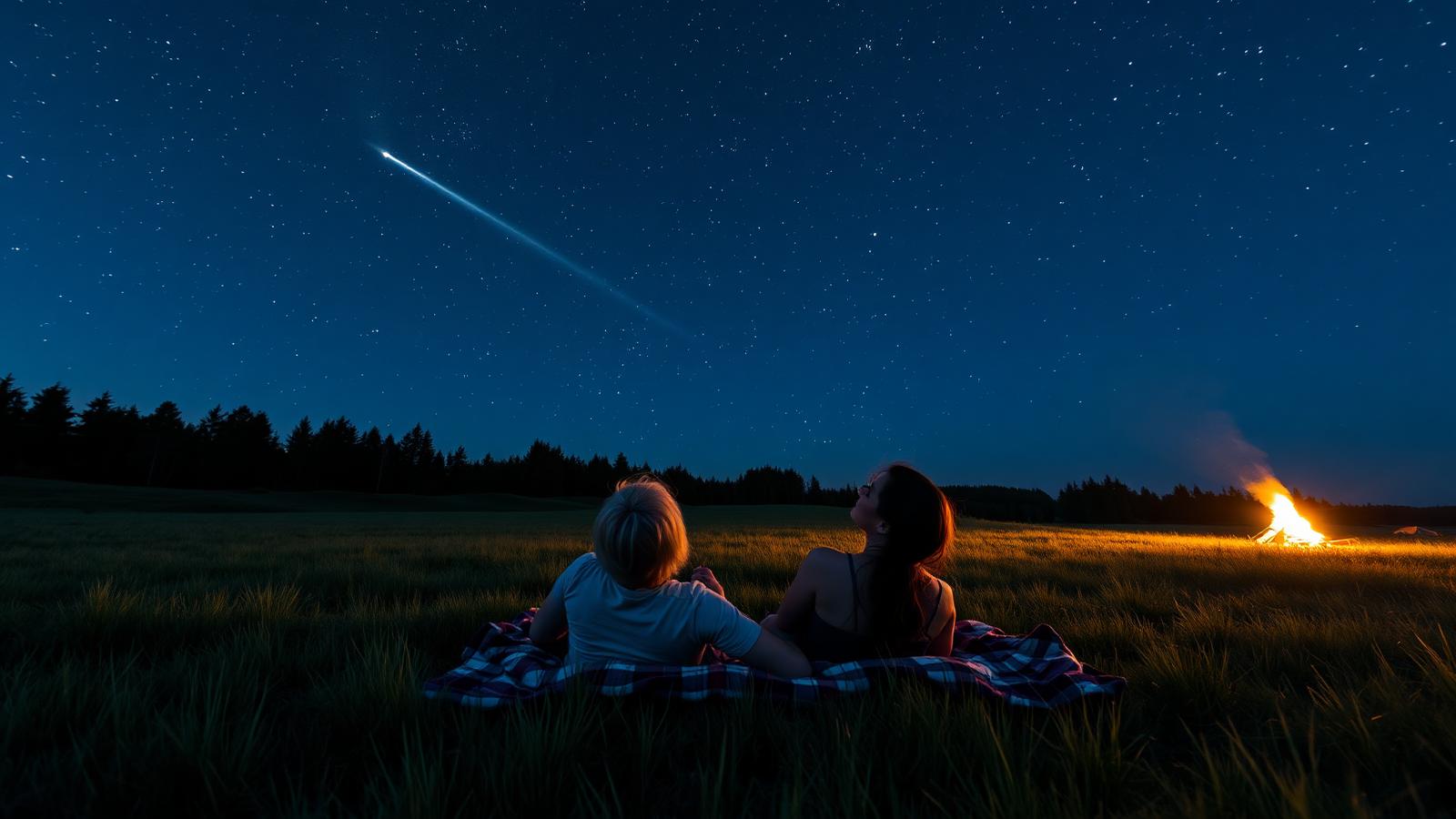
How to watch
A field guide for the peak night
You don't need equipment; you need time, dark, and patience. In that order.
Time. Rates climb through the night as the radiant rises. On the peak night, the two to three hours before local dawn are worth more than the previous five hours combined. Plan a late night or, better, a very early morning.
Dark. A twenty-minute drive out of a city can double your meteor count. Aim for a site where the northeastern-to-eastern horizon is open — trees or a ridge on that side block exactly the direction Perseus rises from. Give your eyes at least 20 minutes to fully adapt after you switch the car off. Any white light — a phone screen, a headlight, someone's torch — resets the clock.
Patience. Meteors are not evenly distributed in time. Five minutes of empty sky, then a Perseid, then two more within a minute, is normal. A single hour is the minimum honest sample; two hours is much better.
Bring a reclining chair or a foam pad — craning your neck for two hours is misery. Even in August, an open field at 03:00 gets cold; a warm jacket and a flask of something hot are not optional.
Photographing the Perseids
Wide lens, open aperture, long night
Meteor photography is a numbers game: you can't predict when a meteor will strike, so you shoot continuously and pray. Use the widest lens you own (14–24 mm on full frame, 10–18 mm on APS-C), open the aperture as wide as it goes (f/2.8 or wider), set ISO 3200–6400, and use continuous 15–20-second exposures. Point the camera about 40° off the radiant — that's where the trails are longest.
Focus manually on a bright star (Vega is well placed in August evenings) and lock the focus with tape. Use an intervalometer or the camera's built-in interval timer with a 1-second gap; that gap saves the battery and gives you a way to reject frames with satellite streaks. Shoot for at least an hour to accumulate enough frames to have several meteors on file.
For a composite image, stack the frames that contain meteors on top of a single well-exposed sky frame. Don't fake it with unrelated frames from other nights, and don't move meteors onto other parts of the sky — the whole point of a Perseid composite is that the trails really do converge on the radiant.
The same day · 12 August 2026
A total solar eclipse crosses Europe hours before the Perseid peak.
The Perseids only peak at New Moon because the eclipse geometry demands New Moon. Anyone under a dark European sky on 12 August 2026 can experience Europe's first total solar eclipse since 1999 in the evening and the year's best meteor shower before dawn. →
Common questions
Frequently asked
Frequently asked questions
Related
Keep exploring tonight's sky
Total solar eclipse — 12 Aug 2026
Europe's first totality since 1999 — same day as the Perseid peak.
All meteor showers this year
Every active shower with peak dates and moon conditions.
Tonight's timeline
Sunset, twilight, moonrise and darkness times for your location.
Milky Way tonight
When the Milky Way core is above the horizon at your location.
Moon tonight
Phase, illumination and moon-set times for your location.
ISS passes tonight
Live ISS pass predictions with direction and altitude.
Sources: peak time and active period from the International Meteor Organization 2026 Meteor Shower Calendar. Moon phase computed via astronomy-engine using the same algorithms as NASA JPL DE-4XX ephemerides. Radiant position (α = 03h 08m, δ = +58°) from the IAU Meteor Data Center. Comet 109P/Swift–Tuttle orbital data from NASA JPL Small-Body Database. See editorial policy for how quantitative claims are checked.