Can you stargaze without a telescope tonight? · Oslo, Norway
CHECKING…
7 of 11 naked-eye targets · best window —
Waiting for live cloud cover at your coordinates.
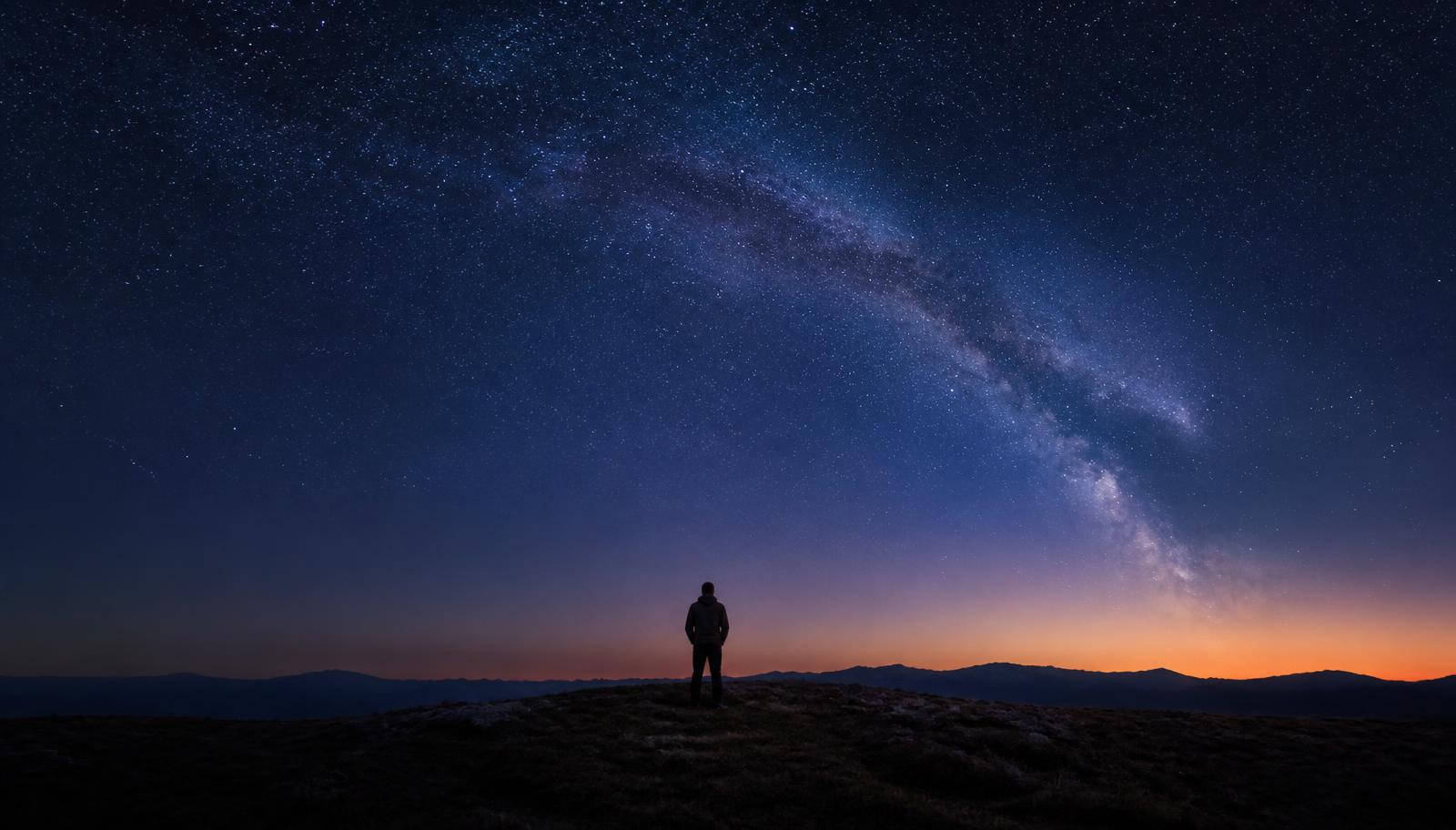
Oslo, Norway ·
Stargazing Without a Telescope
The unaided eye reaches magnitude 6.5, all five naked-eye planets and 2.5 million light years. This page tells you which of those are actually available tonight at your coordinates — and whether it is worth going outside.
- Visible tonight
- 7/11
- Moon
- 54%
- Cloud
- —
- Astro. dark
- 20:23
Fact
Most people can see between 2,000 and 3,000 stars with the naked eye under ideal conditions — and fewer than 50 from an inner-city street.
SnapCosmos fact · live
Tonight only 7 of 11 naked-eye targets are realistically visible from your location.
Live from the Night Engine
Tonight's naked-eye score
Eleven targets, every one of them reachable with no equipment at all, each scored for this location, this night, and tonight's cloud cover.
| Target | Tonight | Why |
|---|---|---|
| The Moon | 54% lit but below the horizon for part of the night | |
| Venus | Below the horizon or lost in twilight tonight | |
| Jupiter | 43° up in the south · mag -2.0 | |
| Saturn | 32° up in the south · mag 0.3 | |
| Mars | 48° up in the south · mag 1.0 | |
| Mercury | Below the horizon or lost in twilight tonight | |
| International Space Station | Pass peaking 13° above the horizon | |
| Orionids meteors | Active now — peak ZHR 20/h under perfect dark skies, fewer in real conditions· needs full darkness | |
| The Milky Way | Erased by a 54% Moon· needs full darkness | |
| Andromeda Galaxy (M31) | Moonlight puts it out of naked-eye reach· needs full darkness | |
| Bright stars and constellations | Visible from anywhere, including city centres |
Three stars or more counts as "realistically visible" — meaning a person standing outside with no equipment, reasonably dark-adapted, would actually see it. Cloud cover multiplies every row rather than subtracting from it, which is why an overcast night scores zero across the board instead of averaging out.
Start here
Your shortlist for tonight
- GoodThe Moon54% lit but below the horizon for part of the night
- ExcellentJupiter43° up in the south · mag -2.0
- Very goodSaturn32° up in the south · mag 0.3
- ExcellentMars48° up in the south · mag 1.0
- GoodInternational Space StationPass peaking 13° above the horizon
- GoodOrionids meteorsActive now — peak ZHR 20/h under perfect dark skies, fewer in real conditions
Ranked for the unaided eye at Oslo, Norway. Anything marked as needing darkness assumes the Sun is more than 18° below the horizon.
The instrument you already own
What the naked eye can actually do
Every number below is a property of the human eye, not an opinion about it. Knowing them changes what you look for.
The dark-adapted human eye is a wide-field, low-resolution, extremely sensitive instrument. It reaches roughly magnitude 6.5 from a genuinely dark site, which is about 9,100 stars across the whole sky and somewhere near 2,500–3,000 above the horizon at any moment. It resolves detail down to about one arcminute — coarse enough that Saturn stays a point and fine enough that you can split the Mizar–Alcor pair in the handle of the Plough.
What it does better than any telescope is field of view. A telescope shows you half a degree of sky; your eye takes in almost the entire hemisphere. That is why meteor showers, the Milky Way, aurora, satellite passes and the sheer geometry of the constellations are naked-eye events. Pointing a telescope at any of them makes them worse.
- Faintest star visible
- Magnitude ~6.5
- At a Bortle 1–3 site, fully dark-adapted. Magnitude ~4.0 in a typical suburb.
- Angular resolution
- ~1 arcminute
- Roughly 60× coarser than a small telescope. A 130 km lunar crater is the practical limit.
- Fully dark-adapted pupil
- 5–8 mm
- Shrinks with age: about 7–8 mm at 20, about 5 mm at 60.
- Dark adaptation time
- 30–45 minutes
- 10–15 minutes gets you most of the way. One white screen resets it.
- Naked-eye planets
- 5
- Mercury, Venus, Mars, Jupiter, Saturn. Uranus at magnitude 5.7 is possible from Bortle 1–2.
- Furthest naked-eye object
- 2.5 million light years
- The Andromeda Galaxy, M31, visible as a faint oval from Bortle 4 or darker.
Decision, not description
The three things that decide tonight
Cloud, Moon, darkness — in that order. The Night Engine applies them in exactly this order, and so should you.
Cloud is a gate, not a penalty. No amount of darkness or lunar cooperation rescues an overcast sky, which is why cloud cover multiplies the score rather than subtracting from it. Tonight your location averages an unknown amount of cloud.
The Moon is the largest variable most people ignore. A full Moon brightens the sky by two to three magnitudes, which removes the Milky Way from a Bortle 2 site as effectively as a small city would. It is currently 54% illuminated, and sets at 23:46. For faint targets, a bright Moon that sets early is far better than a thin Moon that stays up all night — which is why altitude matters as much as phase.
Darkness is binary for faint objects. Astronomical darkness begins when the Sun passes 18° below the horizon. Tonight that happens at 20:23 from Oslo, Norway. The Moon, the planets and the ISS do not care about it at all.
Tonight, in one line
Tonight's observing conditions can't yet be evaluated.
Light pollution
How dark your sky needs to be
The Bortle scale is usually presented as a description of the sky. It is more useful as a list of what you are giving up.
| Bortle | Where | Stars visible | What you lose |
|---|---|---|---|
| 1–2 | Remote desert, high plateau, ocean | 2,500–3,000 | Nothing. Zodiacal light and airglow are visible; the Milky Way casts shadows. |
| 3 | Rural, far from any town | ~2,000 | Airglow and the faintest zodiacal band. |
| 4 | Rural–suburban transition | 1,000–1,500 | Milky Way structure flattens; M31 becomes a smudge, not an oval. |
| 5 | Outer suburb | 400–800 | The Milky Way is only glimpsed overhead. Faint meteors vanish. |
| 6–7 | Suburb to city edge | 150–400 | No Milky Way at all. Constellation shapes lose their fainter stars. |
| 8–9 | Inner city | 20–50 | Everything except planets, the Moon, the ISS, and roughly a dozen bright stars. |
The practical threshold is Bortle 4. Below it — that is, darker — the Milky Way is a structure rather than a rumour, and the Andromeda Galaxy becomes an object rather than a claim. For most people that is a 30–60 minute drive, and it is the single highest-value thing a beginner can do without spending money. Our flagship dark-sky location pages publish ten-year clear-night statistics for sites that qualify.
Honest comparison
Naked eye vs binoculars vs telescope
Three of these targets are actively better without equipment. Knowing which three saves beginners a lot of money and disappointment.
| Target | Naked eye | 10x50 binoculars | Small telescope |
|---|---|---|---|
| The Moon | Maria, terminator, craters over ~130 km | Dozens of named craters, mountain ranges | Rilles, central peaks, crater chains |
| Jupiter | A brilliant steady point, brighter than any star | Four Galilean moons as pinpricks | Cloud belts, the Great Red Spot |
| Saturn | A yellowish steady point | An oval, not a disc — rings hinted | Rings clearly separated, Cassini division |
| The Milky Way | A luminous band across the whole sky | Resolves into countless individual stars | Too narrow a field — worse than the eye |
| Andromeda (M31) | A faint oval smudge from Bortle 4 or darker | Clear elongated glow with a bright core | Core detail, companion galaxies |
| Meteor showers | Ideal — you need the widest field there is | Actively worse | Useless |
| The ISS | A bright, fast, silent, non-blinking star | Hard to track, occasionally a shape | Only with tracking practice |
| Aurora | Ideal — full-sky structure and motion | Loses the structure | Useless |
Field method
The 20-minute field routine
Follow it in order. Most failed nights are failures of sequence, not of sky.
- 1Check whether tonight is worth it at all — cloud cover, moon illumination and darkness decide it before you open the door.
- 2Get away from direct light. You do not need a dark site to start; you need no lamp shining into your eyes.
- 3Give your eyes 20 minutes with no white screens. Dim red light only.
- 4Start with the bright anchors: the Moon, any visible planets, and one large constellation you can name.
- 5Use averted vision for faint objects — look 10–15° to the side of the target and let your rod cells do the work.
- 6Look 30° or higher above the horizon whenever you can; the atmosphere near the horizon eats contrast.
- 7Finish with one deliberate five-minute stretch of just lying back and watching for meteors and satellites.
Averted vision is the one technique that feels like cheating. Your central vision is cone-dominated and nearly blind to faint light; the rods peak about 10–15° off-axis. Look slightly to the side of the Andromeda Galaxy and it appears. Look straight at it and it vanishes.
Evergreen
Month by month, with no equipment
A northern mid-latitude year, written as a list of naked-eye headlines rather than a list of objects.
| Month | Headline target | Why |
|---|---|---|
| January | Orion, Sirius, the Winter Triangle | The brightest constellation field of the year, and long nights to use it. |
| February | The Pleiades and Taurus high overhead | Best month to count Pleiades stars — six is average, nine is a dark sky. |
| March | Zodiacal light after dusk | The false dusk cone in the west, only from Bortle 1–4. |
| April | Lyrid meteors, Leo rising | First warm-ish nights, though darkness is already shortening. |
| May | Eta Aquariid meteors, Arcturus | Halley's Comet debris; better from lower latitudes. |
| June | Noctilucent clouds | At 50–65°N there is no astronomical darkness — but electric-blue NLCs replace it. |
| July | The Milky Way core returning | Late July nights finally darken again in the north. |
| August | Perseid meteors, Milky Way at its best | The one night of the year most people go outside. |
| September | Andromeda at the zenith | The furthest thing the human eye can see, straight overhead. |
| October | Orionids, Milky Way in the west | Long nights return with the Milky Way still up after dusk. |
| November | Taurids and Leonids | Slow bright fireballs from the Taurids are a naked-eye speciality. |
| December | Geminid meteors, Orion back | The strongest reliable shower of the year, and the longest nights. |
Failure modes
Five mistakes that cost people the sky
1. Going out on the wrong night. Most people choose by calendar convenience. The sky is chosen for you by cloud, Moon and darkness, and any two of those can be wrong at once. This is the entire reason SnapCosmos exists.
2. Using a phone screen. Twenty minutes of dark adaptation, undone in one second of white light. Red mode, lowest brightness, or leave it in a pocket.
3. Looking too low. At 20° above the horizon you are looking through nearly three times the atmosphere you look through at the zenith, plus every streetlight in the district. Wait for altitude.
4. Expecting photographs. Long-exposure images collect light for thirty seconds; your eye integrates for about a tenth of a second. The Milky Way is real, but it is grey, not pink.
5. Getting cold. Standing still at night costs more heat than any other outdoor activity of equivalent effort. Nobody has ever cut a session short because the sky ran out.
Unpopular but true
What most websites won't tell you
Six things that are widely known among people who observe regularly, and almost never written down for people who don't.
The Moon ruins a night more often than cloud does.
Below about 20% cloud, thin cloud costs you almost nothing. A 90% Moon costs you the Milky Way, Andromeda, and every faint meteor — from any site, at any altitude, no matter how dark it is. Moon phase is the first thing to check, not the last.
Binoculars outperform a cheap telescope for most beginners.
A £80 telescope on a wobbly mount shows less than a £80 10x50 binocular, and gets used a tenth as often. The failure is never optical quality — it is setup time.
You do not need a telescope to enjoy Saturn.
Naked-eye Saturn is a steady, butter-coloured point that does not twinkle, sitting in a part of the sky where nothing else is that bright. Knowing that you are looking at a ringed world 1.4 billion km away is most of the experience; the rings are a bonus a binocular hints at.
Most people fail because they never dark-adapt.
Fifteen minutes decides whether you see 200 stars or 2,000. Almost nobody waits, and almost every disappointed first night is explained by this alone.
A 40-minute drive beats any equipment purchase.
Moving from Bortle 7 to Bortle 4 roughly triples the number of visible stars and switches the Milky Way on. No affordable instrument does anything comparable.
The photographs you have seen are not what the eye sees.
Long exposures accumulate colour your retina cannot. The real Milky Way is grey, structured and quietly astonishing. Expecting the photograph is the fastest way to be let down by the sky.
Key facts
- Faintest naked-eye star
- Magnitude 6.5Dark site, fully adapted. Roughly magnitude 4.0 in a suburb.
- Stars visible at once
- 2,500–3,000From Bortle 1–3. Falls to 20–50 in an inner city.
- Naked-eye planets
- 5Mercury, Venus, Mars, Jupiter, Saturn.
- Dark adaptation
- 30–45 minutesTen to fifteen minutes gets most of the benefit.
- Darkest sky needed for the Milky Way
- Bortle 4 or darkerThe single most common reason people never see it.
- Cost of a full Moon
- 2–3 magnitudesEnough to remove the Milky Way from an otherwise perfect sky.
- Minimum useful target altitude
- 30°Below that you look through more than twice as much atmosphere.
- Equipment required
- NoneWarm clothing and a red light are the only real accessories.
Questions answered on this page
- Can you actually stargaze without a telescope?
- How many stars can I see with the naked eye tonight?
- What is visible right now from my location without equipment?
- Do I need to leave the city to see the Milky Way?
- How long do my eyes take to adapt to the dark?
- Which planets can I see without a telescope?
- Is the Moon helping or hurting tonight?
- Should I buy binoculars or a telescope first?
- What is the best month for naked-eye stargazing?
- What can I never see without a telescope?
Frequently asked questions
Why we are different
Most sky sites answer "what are the conditions". We answer "should I go".
| A typical sky site | SnapCosmos |
|---|---|
| Shows the weather forecast | Turns it into one instruction: go, wait or skip |
| Shows the Moon phase | Explains what that phase actually costs you tonight |
| Shows cloud cover | Ranks tonight against ten years of nights at your coordinates |
| Shows tonight | Compares tonight with the next seven nights and names the better one |
| Generic for everyone | Weighted by what you came to see, and how far you will drive |
| States conditions | States a confidence percentage and what would change it |
| No published accuracy | Publishes its measured agreement, goal by goal, including where it is weak |
Where these numbers come from
The static figures on this page — magnitude limits, resolution, adaptation times, Bortle star counts — are standard values from the observational literature. Everything location-specific is computed live from the sources below at your coordinates.
- Hourly cloud cover, precipitation, humidity and visibility forecastsOpen-Meteo forecast and archive APIOpen-Meteo
- Sun, Moon and planet positions, rise and set times, twilight phasesAstronomy Engine (VSOP87 / ELP2000 series)Don Cross, after the IMCCE and JPL analytical theories
- Ten-year cloud-cover climatology and historical night rankingERA5 reanalysisECMWF / Copernicus Climate Change Service
- Bortle class and sky-brightness context for each locationWorld Atlas of Artificial Night Sky Brightness (Falchi et al., 2016)Science Advances / Light Pollution Map
- Definitions of civil, nautical and astronomical twilight, and lunar phase conventionsAstronomical Applications DepartmentUnited States Naval Observatory
- ISS orbital elements (TLE), propagated locally with SGP4CelesTrak / NORAD two-line elementsCelesTrak, from US Space Force tracking data
Figures on this page last recomputed .
Keep going
- Tonight's sky guideThe full verdict for your location, hour by hour.
- How to see the Milky WayThe one naked-eye target that genuinely needs a dark sky.
- What time does it get dark tonight?Sunset, blue hour and astronomical darkness for your coordinates.
- Meteor showersThe purest naked-eye event there is.
- Planets tonightWhich of the five are up, and where to look.
- Dark-sky locationsTen-year clear-night records for flagship sites worldwide.